How Do GSM and Martindale Ratings Help You Choose Curtain Fabric?
Table of Contents
GSM and Martindale ratings can help you compare curtain fabric, but neither one can tell you by itself whether a curtain will darken a room, drape elegantly, or last well in your home. GSM tells you the fabric’s weight per square meter; it is useful for anticipating body, handling, and the way a panel may hang. Martindale measures resistance to surface abrasion, which is generally much more important for upholstery than for curtains.
For blackout or dimout curtains, start with the claimed light-control function, then verify the construction behind that claim: lining or backing, weave density, layers, color, and actual light transmission. Use curtain fabric GSM Martindale information as supporting evidence rather than as a shortcut to quality.
What GSM tells you about curtains
GSM means grams per square meter. It is the weight of one square meter of fabric, not a direct score for quality, opacity, durability, or blackout performance.
A lower-GSM fabric is often lighter and may produce a softer, airier look. Sheers commonly fall below about 120 GSM, while many everyday dimout fabrics fall roughly within the 150 to 300 GSM range. Coated blackout fabrics and velvets may be above 300 GSM. These are useful comparison ranges, not universal product rules: fiber type, weave, finishing, and the presence of lining can change how a curtain feels and performs.
For a shopper, GSM is most useful for predicting practical qualities:
- Drape and fullness: A heavier fabric usually has more body and can form deeper, more structured folds. That can look luxurious on wide windows, but it can also look bulky in a small room.
- Handling and hardware needs: Heavier finished panels place more load on rods, tracks, brackets, rings, and motorized systems. The weight of lining, interlining, and backing matters in addition to the face fabric GSM.
- Visual coverage: Weight may contribute to a less transparent appearance, but it does not prove opacity. A loosely constructed heavy fabric can allow more light through than a lighter fabric with a dense weave or blackout backing.
- Feel and profile: A medium-weight face fabric paired with lining can offer a refined drape without the stiffness or bulk of an extremely heavy unlined panel.
As JOTEX Fabrics notes, GSM does not independently measure durability, fade resistance, opacity, or overall quality. Yarn quality, fabric structure, and finishing all remain important.
Why a higher GSM does not automatically mean better blackout
“Blackout” describes a light-control result, not a fabric weight category. A curtain can be heavy and still transmit visible light if the weave is open or the fabric lacks an effective backing. Conversely, a comparatively moderate-weight face fabric can perform very well when paired with a blackout lining.
A blackout result can come from several constructions:
- a tightly woven multi-layer fabric, sometimes described as triple weave;
- an internal dark layer within the construction;
- a coated or foam-backed reverse side;
- a separate blackout lining behind a decorative face fabric; or
- multiple layers, such as face fabric, interlining, and lining.
This is why two curtains with similar GSM can perform very differently. The blackout fabric construction guide from ZZA Curtain advises evaluating weight alongside construction, color, finishing, and a physical light test rather than treating GSM as a standalone blackout rating.
Blackout versus dimout: ask what the label means
A dimout curtain is intended to reduce and soften incoming light. It may make a room comfortable for watching television, reduce glare, add privacy, and create a darker atmosphere without eliminating daylight.
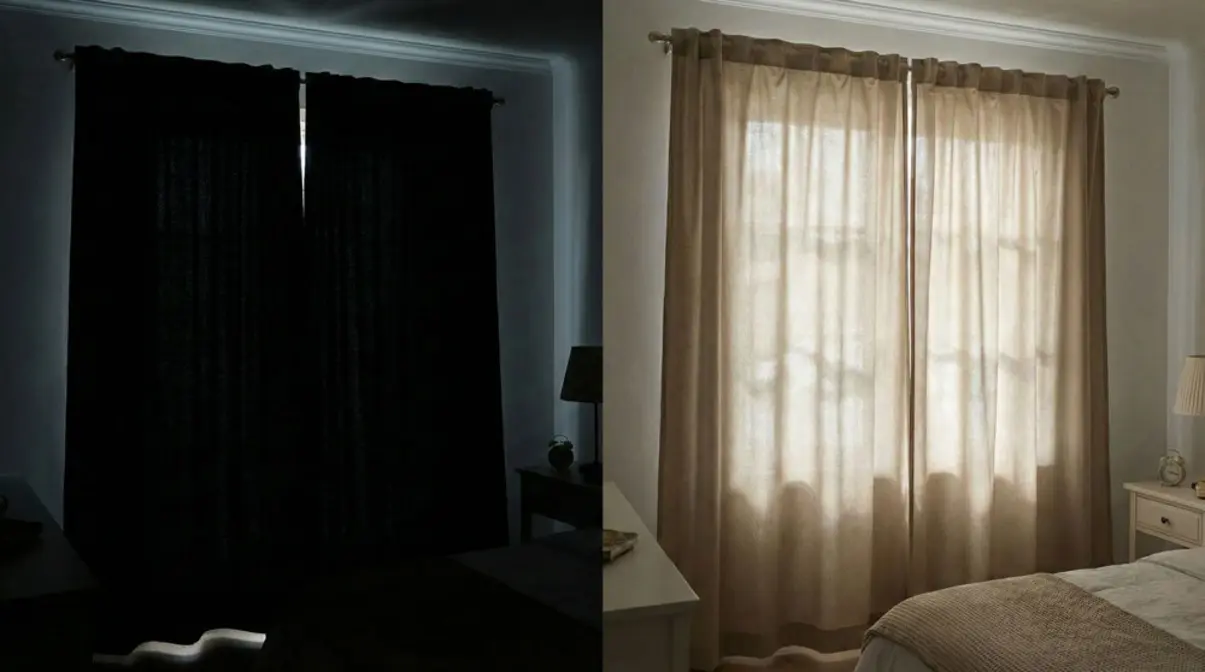
A blackout curtain is intended to block much more external light. However, the term alone does not tell you how complete the room-darkening effect will be once the curtain is installed. Light can enter around the sides, above the rod, below the hem, or through gaps between panels. Pale colors, installation details, and construction can also affect the visible result.
If darkness is your priority, ask the seller for a light-blocking percentage or a clear statement of the finished panel’s performance. Also ask whether the product is inherently blackout, blackout-lined, coated, or simply described as room-darkening. A 200 GSM decorative fabric with a quality blackout lining may be a better choice than a heavier unlined fabric, depending on the window and the look you want.
Source: begoodtex
What Martindale ratings measure—and why curtains usually need less emphasis
The Martindale test assesses abrasion resistance by rubbing a fabric in a controlled way. It is commonly used when evaluating upholstery fabrics because sofa seats, dining chairs, and other frequently touched surfaces experience repeated friction.
For curtain fabric, abrasion is usually not the main stress. Curtains are normally moved, drawn, opened, and closed, but they are not subjected to the same continuous rubbing as a chair seat. That means a high Martindale figure should not be the deciding factor for ordinary window curtains.
Martindale information may still be relevant when:
- you are considering a fabric that could be used for both curtains and upholstery;
- curtains will be handled very frequently, such as in hospitality or commercial spaces;
- a fabric has a delicate surface, pile, metallic detail, or raised texture that could wear from rings or repeated handling; or
- you want to compare multiple decorative fabrics with otherwise similar construction.
Even then, Martindale does not assess every kind of durability. It does not directly tell you how well a curtain resists sun fading, whether a coating will remain intact, how a fabric will drape after cleaning, or whether the finished panel will block light. A high abrasion rating is not proof of superior curtain fabric quality.
The distinction matters because upholstery fabric ratings answer a different question: how well does the surface tolerate rubbing? Curtain selection also requires answers about light, privacy, hanging behavior, appearance, and window coverage.
Read the full curtain specification, not just the headline number
When comparing two blackout or dimout options, use this order of importance.
1. Confirm the light-control construction
Find out whether the curtain is unlined, dimout-lined, blackout-lined, coated, or woven as a multi-layer blackout. If the retailer provides light-transmission information, that is more directly useful than GSM for a dark-room goal.
Hold a sample in front of a window or bright light when possible. Look for pinpoints of light, uneven density, and the difference between the fabric face and reverse. The JOTEX guide specifically recommends comparing samples side by side at a window because weight, weave, and transmitted light reveal more together than one specification does.
2. Check lining and total panel construction
Do not assume the listed GSM represents the complete curtain. Product listings may refer to the face fabric only, while the finished panel includes a lining, backing, or additional layer.
A lining can improve light control, privacy, drape, and protection for the decorative face fabric. It can also increase total weight. If you are ordering custom curtains, ask for the makeup of every layer and whether the GSM refers to the face fabric or the complete construction.
3. Consider weave, fiber, and surface finish
A tight weave generally offers better coverage than an open one at a similar weight. Velvet may look dense because of its pile, while a smooth coated blackout may achieve stronger light control with a different appearance and hand. A textured weave can be attractive but may not be the best choice if the room must be dark during the day.
Fiber content also affects behavior. A fabric’s composition can influence its hand, wrinkle tendency, texture, and response to cleaning, but it still cannot substitute for construction information or a sample review.
4. Evaluate drape in the actual room
GSM helps here, but it is not the only variable. Fabric stiffness, weave, lining, heading style, curtain width, and fullness all affect the final folds.
A very heavy fabric may suit a large formal window and provide substantial visual presence. The same fabric may overwhelm a narrow window or become awkward on a light-duty rod. For tall windows or motorized tracks, confirm the finished panel weight with the installer or manufacturer.
5. Check color and light-fastness separately
A dark color can make a curtain appear more light-blocking, but it does not replace a blackout construction. Likewise, a fabric that feels substantial may still fade if it receives strong sun exposure and has limited light resistance.
Ask about light-fastness when curtains will face prolonged direct sunlight. This is a separate performance property from Martindale abrasion and GSM.
A practical way to compare two curtain listings
Suppose one panel is a 320 GSM unlined textured fabric and the other is a 200 GSM smooth face fabric with blackout lining. The first may feel heavier, but the second may provide stronger room darkening because its lining is designed to stop light. The first might be preferable if you want texture, a particular drape, and only moderate light reduction. The second may be the better choice for a bedroom, nursery, shift worker, or media room.
Now suppose two panels both say “blackout.” Compare whether either listing identifies the backing or lining, gives a light-blocking claim, shows the reverse side, and explains the finished construction. If those details are absent, a fabric swatch and a simple window test are more informative than choosing based on GSM alone.
A discussion in this Reddit thread about blackout versus dimout curtains highlights the same shopper confusion: GSM, Martindale, and the word “blackout” do not independently guarantee performance. The supplied excerpt is a useful reminder to read several specifications together rather than treating a marketing label as a complete answer.
The best decision rule
Choose curtain fabric based first on the job it must do. For daytime privacy and a light, relaxed look, prioritize weave appearance and drape. For glare reduction and softened daylight, choose a dimout construction that suits the room. For sleep, media viewing, or daytime darkness, prioritize verified blackout construction, lining or backing, and installation that limits edge gaps.
Then use GSM to judge weight and hanging behavior. Treat Martindale as a secondary detail unless the fabric will receive unusually frequent handling or must also serve as upholstery. That approach gives you a more reliable picture of curtain fabric quality than any single number on a product listing.
References
- Fabric Weight (GSM) Explained for Curtains and Upholstery | JOTEX Fabrics. jotexfabrics.com. https://jotexfabrics.com/guides/fabric-weight-gsm
- Curtain GSM explained: light, drape and weight by room. encasaxo.com. https://encasaxo.com/blogs/guides/curtain-gsm-guide
- Blackout Curtain Fabric Guide: Construction, GSM & Sourcing. zzacurtain.com. https://zzacurtain.com/insights/blackout-curtain-fabric-guide
- Understanding GSM in Fabrics: What It Means and Why .... kuttons.com. https://www.kuttons.com/blogs/news/understanding-gsm-in-fabrics
- Not all curtain fabric is the same, and GSM is the reason .... facebook.com. https://www.facebook.com/61565034366282/videos/not-all-curtain-fabric-is-the-same-and-gsm-is-the-reason-why-gsm-grams-per-squar/879429025148206
- Curtain Fabric Weight (GSM) Guide by End Use. dairui-curtain.com. https://dairui-curtain.com/curtain-fabric-weight-gsm-guide
- Curtain Panel Opacity Explained: A Homeowner’s Guide. workroom-wisdom-and-fabric-finds.ghost.io. https://workroom-wisdom-and-fabric-finds.ghost.io/curtain-panel-opacity-explained-a-homeowners-guide
- Curtain Fabric Weight Guide: How to Pick the Best GSM – NICETOWN. nicetown.com. https://nicetown.com/blogs/news/curtain-fabric-weight-guide-pick-gsm