How Fabric Construction Influences Custom Bag Durability and Cost
Table of Contents
Why a Fabric Name Is Not Enough for Production
Names such as polyester Oxford, nylon ripstop, canvas, or 600D fabric are useful starting points, but they are not complete production specifications. Denier is a direct yarn-count system based on yarn mass per unit length. It indicates the linear mass of a yarn, not the finished weight, strength, coating level, or service life of a fabric. A fabric made with a given nominal denier can therefore differ substantially from another fabric carrying the same denier description.
Finished performance depends on the complete construction. Fiber type, yarn filament or staple form, yarn twist, warp and weft yarn sizes, weave, ends and picks density, coating, backing, and finish all affect GSM, stiffness, hand, abrasion response, tear propagation, and sewing behavior. Two fabrics described as 600D polyester, for example, may have visibly different cover, body, opacity, and resistance to distortion.
For custom bag production, the material specification should identify at least:
- Fiber content and yarn details in warp and weft
- Weave or construction type, plus ends and picks where relevant
- Nominal fabric weight and allowable tolerance
- Usable width, not only loom width
- Color standard, face and back appearance, and finish
- Coating, lamination, backing, or reinforcement details
- Performance requirements and applicable acceptance tests
This level of detail reduces the risk that a supplier makes an unapproved substitution or interprets a broad material name differently from the approved sample.
How Yarn Size and Fabric Density Interact
Coarser yarns can add mass, texture, and apparent substance, but yarn size alone does not establish a bag fabric’s load-bearing capacity. Strength also depends on fiber properties, yarn construction, yarn count in both directions, weave, finishing, and how the bag transfers load through seams and attachments.
Ends per unit width and picks per unit length influence fabric cover and packing. Higher density can reduce open space between yarns, increase fabric mass, improve surface stability, and make the fabric more resistant to cutting or abrasion in some uses. It can also increase material consumption and reduce flexibility. The resulting effect is not linear: a tightly set fabric made from weak yarns may still perform poorly, while a lighter construction with well-designed reinforcement may be suitable for the same bag category.
A denser construction is not automatically the best choice for tear performance. Some yarn movement can help redistribute stresses around a damaged area, while a very rigid construction may concentrate stress differently. The relevant question is how the specific fabric behaves under the likely load, not whether its density is simply higher.
Select density in relation to expected contents, target bag weight, shape retention, and product handling. If high stress is concentrated at handles, strap anchors, base corners, or closures, local reinforcement may deliver more useful durability than making every shell panel heavier.
How Weave Structure Affects Bag Performance
Weave structure is the arrangement of warp and weft interlacements. It affects yarn mobility, flexibility, dimensional stability, snagging tendency, surface texture, yarn packing, and visual character. These effects matter because a bag is cut, sewn, folded, loaded, rubbed against other objects, and repeatedly lifted at localized points.
Source: Unsplash
A weave should therefore be evaluated as part of the finished bag system, not selected solely for its surface appearance. Plain, twill, basket, Oxford, and ripstop constructions represent different balances among stability, drape, weight, sewing behavior, and resistance to damage.
Plain-Weave Construction
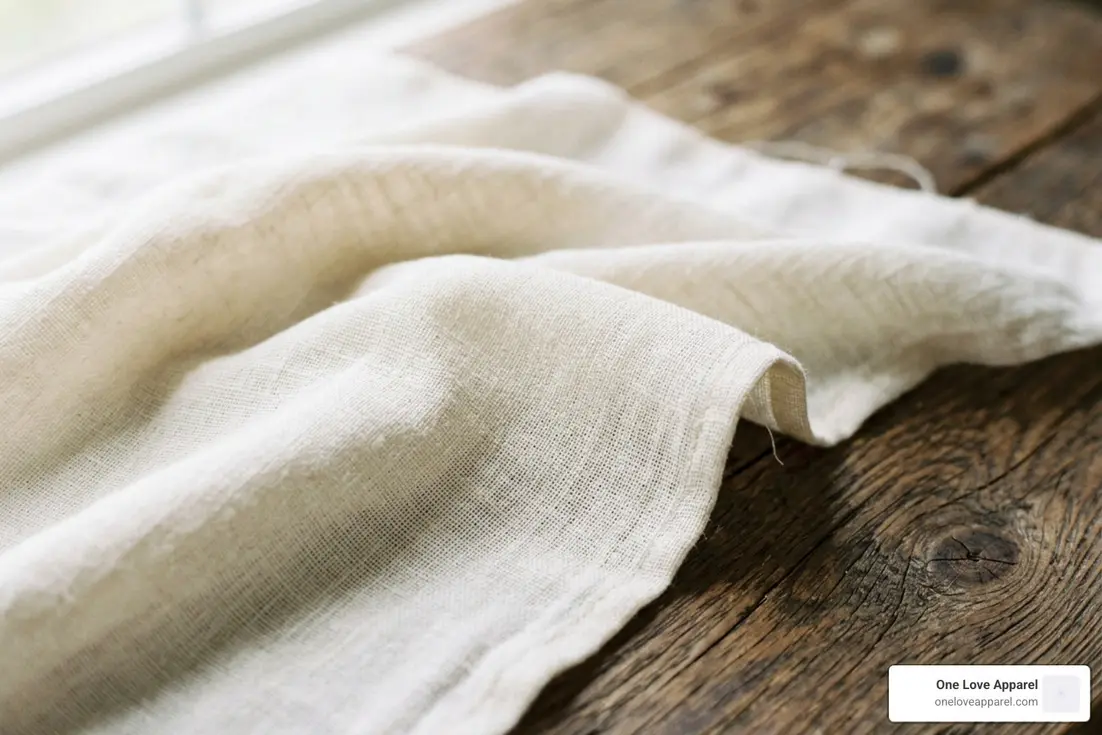
Plain weave has frequent warp-weft interlacements. This arrangement generally provides good geometric stability and helps resist yarn displacement. Its even surface can support consistent printing, coating, and visual uniformity, which is useful for promotional bags, linings, simple utility bags, and printed outer shells.
At comparable yarn size and fabric set, plain weave often has a firmer hand and less drape than twill. That can help a bag retain a clean shape, but it may make folding or turning operations less forgiving when the material is heavy or coated. Lightweight plain-weave shells can still be vulnerable at loaded points, especially around handles, corners, and seam ends. In these cases, reinforcing the load path is usually more effective than assuming the shell alone will carry all stress.
Twill-Weave Construction
Twill weave is recognized by diagonal wales created by its interlacement sequence. Compared with a similar plain weave, twill can combine relatively close yarn packing with flexibility and a softer-looking surface. Its diagonal texture may also make minor scuffs, soil, or surface irregularities less noticeable in some applications.
The longer yarn floats associated with twill can create trade-offs. Depending on yarn type, finish, and use conditions, they may be more prone to snagging, surface abrasion, or distortion than a tightly interlaced plain weave. The construction may be appropriate for bags where drape, appearance, or a softer hand is important, but its suitability should be confirmed by prototype evaluation.
Fabric weight is not a reliable substitute for seam-slippage testing. Assess the actual fabric with the intended seam allowance, stitch type, thread, needle, and loading direction. A fabric can appear substantial while allowing yarns to shift near a stressed seam.
Basket and Oxford Fabric Constructions
Basket constructions use grouped yarns rather than individual yarns at every interlacement. They can create visible texture, a substantial hand, and an appearance often associated with utility or casual bags. Oxford-type fabrics are widely used for promotional, school, travel, and general-purpose bags, but Oxford is not a single standardized performance grade.
An Oxford fabric’s stability and stiffness depend on its yarn size, fiber quality, fabric set, weave variation, coating, and finishing. A tightly constructed, coated Oxford may feel structured and sew differently from a lighter, more open Oxford made with similar nominal yarn counts. Looser constructions may distort more easily around seams, strap attachments, and corners, particularly when sewing tension is high or the bag is heavily loaded.
Ripstop Fabric Constructions
Ripstop is a construction concept rather than a guarantee of overall strength. It generally consists of a lighter base fabric with periodically spaced heavier or stronger reinforcement yarns that form a visible grid. The grid can help limit the spread of a tear while preserving relatively low overall fabric mass.
Ripstop should not be treated as puncture-proof, seam-proof, or attachment-point-proof. A sharp object can puncture the base fabric, and a handle attachment can fail even if the panel itself resists tear propagation. Grid spacing, reinforcement yarn type, base fabric density, coating, and seam placement all influence performance. A fine grid may look different and behave differently from a wider grid, even where the finished fabric weight is similar.
How Coatings and Backings Transform Bag Fabric
Coatings, laminations, nonwoven backings, foam layers, and fused reinforcements can change a fabric more dramatically than a weave change alone. They may improve water resistance, opacity, body, fray resistance, print appearance, and shape retention. They also increase GSM and can alter the material’s hand from soft and flexible to stiff and board-like.
Source: Unsplash
These added layers affect manufacturing. They can increase seam bulk, require different needles and thread, change feeding through sewing equipment, and create heat sensitivity during printing, bonding, or storage. Some coated fabrics also require careful handling to prevent blocking, creasing, cracking, or surface marking.
Layer adhesion is a separate durability concern. A face fabric may remain intact while a coating, film, or backing separates under flexing, moisture exposure, heat, or stress. For this reason, a specification should define the coating or backing type, its location, total weight, and any adhesion or flex-related acceptance criteria.
Water-resistant fabric does not automatically produce a waterproof bag. Seams, needle holes, zippers, folded openings, and hardware interfaces can admit water. Waterproof performance requires evaluation of the completed bag construction, including seam sealing or other assembly measures where needed.
Comparing Common Bag Fabric Construction Options
The following comparison is directional rather than absolute. Actual performance depends on the specific yarns, fabric set, finishing, and bag design.
| Construction option | Typical advantages | Key limitations to evaluate |
|---|---|---|
| Lightweight plain weave | Low mass, stable surface, straightforward printing and coating | May lack body and local tear resistance as an outer shell |
| Dense plain weave or canvas | Firm hand, stable seams, durable appearance | Higher weight, bulk, and potentially slower cutting or sewing |
| Twill | Flexible hand, diagonal visual effect, scuffs may be less visible | Snagging, float abrasion, seam slippage, and distortion need review |
| Basket or Oxford | Textured appearance and broad utility-bag use | Performance varies greatly with yarns, set, coating, and finish |
| Ripstop | Can limit tear propagation at relatively low mass | Does not replace puncture, seam, or attachment reinforcement |
| Coated or laminated fabric | Improved structure, opacity, and water resistance | Added stiffness, processing complexity, weight, and adhesion risk |
The most suitable option is the construction that meets the intended use with manageable manufacturing risk. A fabric category name should never replace sample approval and production testing.
Why the Lowest-Cost Fabric May Raise Total Bag Cost
Fabric price per meter is only one part of bag cost. A lower-priced material can create higher total cost if it has poor cutting yield, narrow usable width, excessive fraying, slow sewing behavior, inconsistent coating, or a high reject rate. A material that requires extra patches, binding, seam tape, or handling steps may not remain economical after conversion.
Custom color and specialty finishing can also change the commercial calculation. Minimum order quantities, dye or coating setup, shade-control work, sampling, and longer lead times may be more important than the base price of the greige fabric. These factors should be considered before a bag is quoted or a material is approved.
Heavier shells can affect more than freight. They may require stronger thread, larger needles, changed seam construction, stronger hardware, additional reinforcements, and more labor during turning or assembly. Compare candidate materials on finished-bag cost, cutting and sewing efficiency, quality risk, packing density, and transport burden—not only on unit fabric price.
Reinforce Load Paths Instead of Every Panel
When a prototype fails, the problem is often localized rather than evidence that every panel needs a heavier fabric. Concentrated loads commonly enter through handles, shoulder straps, zipper ends, drawcord channels, base corners, and panel seams. These areas should be examined as connected load paths.
Useful reinforcement options include patches, folded fabric constructions, wider seam allowances, bar tacks, additional stitch rows, compatible backings, and larger attachment footprints. The selected method must match the base fabric and the direction of loading. A stiff patch on a flexible shell, for example, may shift stress to the edge of the patch rather than solving the underlying problem.
Failure beside a patch or through stitch perforations can indicate poor reinforcement geometry, an oversized needle, unsuitable stitch density, incompatible thread, weak backing, or an inappropriate seam design. Review the complete assembly rather than increasing fabric weight without identifying the failure mode.
Match Testing to the Failure Mode You Need to Prevent
Testing should target the damage most likely to occur during use, transport, cleaning, or storage. Relevant evaluations may include abrasion, tear, tensile behavior, seam slippage, coating adhesion, color transfer, and water penetration. Fabric tests are valuable, but they do not fully predict bag durability because seams, needles, stitch construction, hardware, and strap attachments can govern failure.
Methods such as ASTM D3884 and ISO 12947 are commonly associated with abrasion evaluation, while ASTM D2261 is associated with tear evaluation. Their current applicability, edition, apparatus, and scope should be confirmed before use. A method number alone is not a complete requirement.
A usable test instruction should state the specimen preparation, conditioning, direction of test where relevant, test endpoint, sampling plan, and acceptance limit. Finished-bag testing should then reflect realistic loads and handling, particularly for handles, straps, closures, and loaded seams.
Details to Approve Before Bulk Bag Production
Bulk production should be controlled by an approved material and construction record, not by a general description in an order sheet. The record should identify the fiber, yarn, weave, weight, usable width, color, and finish. It should also define face and back appearance, coating or backing, reinforcement locations, and critical sewing parameters.
Include applicable test methods and clear acceptance limits. Approval should be tied to a named material code, sealed swatch, or physical approved sample that can be compared with incoming production fabric. For bags with critical appearance or function, retain an approved finished sample as well.
Any substitution or construction change—including yarn count, density, coating, backing, color source, or weight—should require written authorization before bulk production. This protects both appearance and performance from changes that may seem minor at fabric level.
Select the Lightest Construction That Meets the Required Use
The preferred custom bag fabric construction is usually the lowest practical weight that reliably meets expected use, shape retention, appearance, production consistency, and cost requirements. Heavier fabric is not automatically more durable, and a lower-GSM fabric is not automatically inadequate.
Evaluate yarn, weave, density, coating, backing, local reinforcement, seam design, and probable failure modes as one system. Place reinforcement where loads enter and travel through the bag rather than adding mass uniformly across every panel.
Finally, document the approved construction in enough detail that future production can reproduce the intended material, appearance, and performance. That discipline turns fabric selection from a broad marketing description into a repeatable manufacturing decision.