Eco-Friendly Textile Dyeing and Finishing Techniques

Table of Contents
Introduction to Sustainable Dyeing and Finishing
Eco-friendly textile dyeing and finishing techniques are approaches designed to lower the environmental burden of coloration, preparation, and functional treatment. In practice, this means reducing process-water consumption, thermal energy demand, hazardous chemical inputs, unfixed colorant losses, and the pollutant load of wastewater. A lower-impact process should also be assessed for worker exposure, product durability, treatment requirements, and end-of-life implications.
Conventional wet processing can require repeated washing, heating, chemical dosing, and rinsing steps. Dye baths, wash-off liquors, salts, alkalis, surfactants, reducing agents, and finishing formulations may contribute color, organic load, dissolved solids, or persistent chemicals to wastewater. The environmental performance of a mill therefore depends not only on the dyeing method itself, but also on water reuse, heat recovery, chemical management, and effluent-treatment capability.
Lower-Impact Dyeing and Finishing Methods
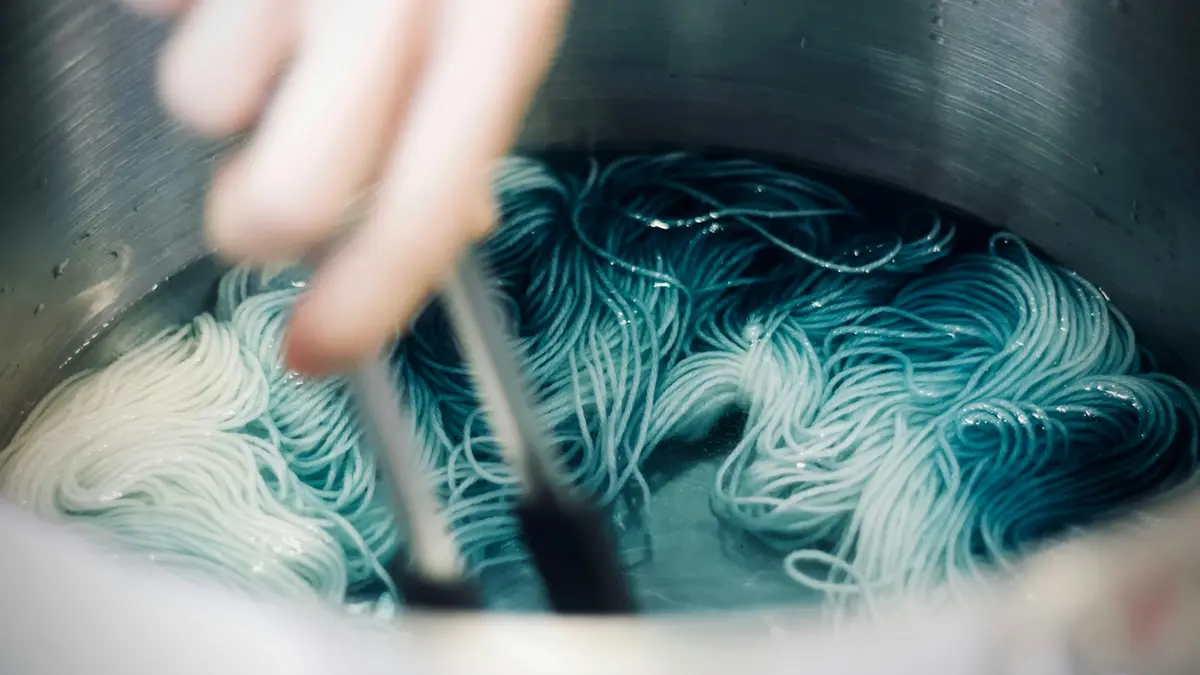
No single process is environmentally preferable for every fiber, shade, product, or production scale. Natural colorants, high-fixation synthetic dyes, waterless systems, plasma treatment, enzymes, and nanomaterial-based finishes each address different parts of the textile-processing footprint. Their benefits should be evaluated alongside equipment needs, electricity source, chemical formulation, durability, wastewater treatment, and realistic production conditions.
Source: Unsplash
Natural Colorants
Natural colorants are obtained from biological or mineral sources. Common examples include indigo from plant-derived sources, madder for red and orange-red shades, and cochineal, an insect-derived red colorant. Other natural dye sources include leaves, bark, roots, flowers, fruit residues, algae, minerals, and some animal-derived materials.
These colorants may offer a renewable alternative to some synthetic dye systems, and certain natural dyes may be biodegradable or present lower toxicological concerns than selected conventional dye formulations. However, “natural” does not automatically mean safe, low-carbon, non-toxic, or low-water. Agricultural land use, irrigation, harvesting, extraction, transport, solvent use, and dye-bath chemistry all influence the final environmental profile.
Natural dyeing also presents technical limitations. Shade reproducibility can vary with source material, season, extraction method, water quality, fiber type, and dye concentration. Wash, light, and rubbing fastness may be inconsistent unless the process is carefully optimized. Mordants are often used to improve dye uptake or fastness, but mordant selection is important: some metal-containing mordants can introduce environmental and worker-safety concerns. A responsible natural-dye process therefore requires controlled sourcing, standardized recipes, compatible mordants, and wastewater management.
Low-Impact Synthetic Dyes
Low-impact synthetic dyes are dye systems selected or formulated to reduce hazardous inputs, improve dye utilization, and limit residual color in wastewater. The term is not a universal chemical classification. It commonly refers to dyes and dyeing systems with improved fixation, lower levels of restricted substances, or process conditions that use less water, salt, energy, or auxiliary chemistry than less efficient alternatives.
Reactive dyes for cellulosic fibers and acid dyes for protein fibers and polyamide can provide strong fiber affinity under suitable conditions. Their fixation behavior depends on the dye structure, fiber chemistry, pH, temperature, time, electrolyte use, and auxiliaries. It is not technically accurate to assume that every reactive or acid dye fixes at a lower temperature than every alternative dye class.
Higher fixation efficiency can reduce the proportion of unfixed dye requiring wash-off and treatment. This may lower color loading in the effluent, reduce water use during rinsing, and improve chemical efficiency. It does not eliminate the need for wastewater treatment, because residual dyes, salts, surfactants, alkalis, acids, and other process chemicals can still remain in the discharge stream.
Ultrasound-Assisted Dyeing
Ultrasound refers to sound waves with frequencies above the upper limit of human hearing, conventionally above 20 kHz. Sound propagation may be described through longitudinal wave motion, in which particle movement is parallel to wave travel, and transverse wave motion, in which movement is perpendicular to wave travel. In liquid textile-processing systems, ultrasonic effects are primarily associated with pressure fluctuations in the treatment medium.
A central mechanism is cavitation. Alternating pressure cycles can form, grow, and collapse microscopic bubbles in a liquid. Their collapse can create localized mechanical and chemical effects that intensify mixing, dispersion, and mass transfer. In textile dyeing, these effects may improve the movement of dyes or auxiliaries through the liquor and toward fiber surfaces.
Potential Benefits of Ultrasonic Processing
Ultrasound-assisted processing may support lower-temperature dyeing, shorter treatment times, improved dye dispersion, faster wetting, or improved penetration in selected systems. It may also reduce the amount of certain auxiliaries where cavitation and agitation provide sufficient process intensification.
Potential savings in energy, time, cost, water, and effluent load are process-dependent rather than guaranteed. Equipment geometry, liquor ratio, fabric form, dye class, fiber type, operating frequency, power density, and scale all affect results. Ultrasound is an energy-assisted process; it is not itself a renewable energy source. Its environmental benefit depends partly on how efficiently the system operates and how the electricity is generated.
Air Dyeing Technology
Air dyeing is a broad description for color-application methods in which water is not the primary transport medium for the dye. Depending on the technology, compressed air, heated air, foam, controlled spray, or other low-liquor application systems may be used to distribute colorants onto or into a textile substrate.
Compared with conventional exhaust dyeing, suitable air-based systems can reduce process-water demand and decrease the volume of aqueous wastewater requiring treatment. They may also lower energy use when less water must be heated, circulated, and dried. Actual results depend on the substrate, colorant, fixation method, production speed, and equipment design.
Claims about improved fade resistance, reduced greenhouse-gas emissions, or elimination of hazardous waste should be assessed for each technology and product. Color fastness depends on the dye-fiber interaction, fixation quality, substrate construction, aftertreatment, and exposure conditions. Likewise, a process with little liquid effluent may still require careful management of emissions, cleaning waste, unused chemicals, and energy consumption.
Supercritical-Fluid Processing
A supercritical fluid is a substance maintained above its critical temperature and critical pressure. Under these conditions, it has liquid-like density while retaining gas-like transport properties, such as relatively rapid diffusion and low viscosity. Supercritical carbon dioxide is the most widely discussed example for textile processing.
Polyester Dyeing With Supercritical Carbon Dioxide
Supercritical carbon dioxide can be used with appropriate disperse dyes to color polyester and related hydrophobic polymers. Carbon dioxide under supercritical conditions can carry compatible dyes into the dyeing vessel without using water as the primary medium. The process is especially relevant to polyester because disperse dyes have affinity for hydrophobic polymer structures.
The proposed dyeing mechanism involves carbon dioxide entering and swelling the polymer to some degree, allowing dye molecules to diffuse through available free volume, pores, and capillary pathways. The fluid’s low viscosity can support rapid transport, while the closed system can enable recovery of unused carbon dioxide and, in some cases, residual dye.
This approach can substantially reduce aqueous effluent from the dyeing stage and may support level coloration when process conditions are well controlled. However, it requires specialized high-pressure machinery, process safety controls, compatible dyes, and technical expertise. Energy performance, shade reproducibility, dye recovery, and resulting yarn or fabric properties must be evaluated for the specific equipment and operating conditions.
Plasma and Enzyme-Based Treatments
Plasma treatment is a dry surface-modification method that can alter a textile without immersing it in a conventional chemical bath. Depending on the gas, equipment, and treatment conditions, plasma can modify surface energy, create reactive functional groups, or change surface morphology. These changes may influence wettability, dyeability, printability, adhesion, water repellency, antistatic behavior, and selected mechanical or surface properties.
Because plasma is usually applied as a surface treatment, it can reduce water use and chemical consumption compared with some wet finishing routes. Its limitations include equipment cost, treatment uniformity, speed, durability of the surface effect, and the need to control process gases and energy input.
Enzymes can replace or supplement selected conventional chemicals in textile preparation. Amylase is commonly used in desizing to break down starch-based size materials. Cellulase can support biopolishing or controlled surface modification of cellulosic fibers, while pectinase can assist in removing pectic substances during selected scouring processes. Enzymatic treatments may also be used in washing, degumming, bleaching support, and combined preparation routes.
Enzyme systems can operate under comparatively mild conditions, but their performance depends on pH, temperature, treatment time, substrate composition, water quality, and enzyme stability. Enzymatic bleaching and combined processing may reduce fiber damage or processing intensity in some applications, yet they still require careful formulation, rinsing, and quality control.
Nanotechnology for Textile Finishes
Textile nanotechnology involves the use of materials commonly characterized at dimensions of approximately 1–100 nanometers. At this scale, high specific surface area and surface energy can influence interactions between particles, binders, fibers, and surrounding media. Nanomaterials may be incorporated into coatings or finishes to provide functional performance with relatively low add-on levels.
Nanotechnology can improve the durability or efficiency of selected finishes, but performance is not the only consideration. Particle release during manufacture, wearing, laundering, abrasion, recycling, or disposal may create exposure and environmental concerns. Life-cycle assessment, binder selection, wash durability, worker protection, and regulatory suitability should be considered before commercial adoption.
Functional Properties of Textile Nanoparticles
Different nanoparticles are associated with different textile functions. Silver-containing particles are often used for antimicrobial effects. Iron-based particles may support magnetic or conductive functions. Zinc oxide and titanium dioxide are used in UV-related finishes and can also exhibit photocatalytic activity under suitable conditions.
Silica, alumina, ceramic particles, carbon black, clay materials, and cellulose nanomaterials may be used in systems intended to improve water repellency, abrasion resistance, conductivity, wrinkle resistance, stain resistance, barrier performance, or surface durability. Indium-tin oxide has also been used in infrared-management applications.
Functional performance depends on particle size and shape, concentration, surface treatment, dispersion quality, binder chemistry, fabric construction, coating continuity, curing conditions, and intended end use. A laboratory result does not automatically demonstrate safe, durable, or commercially viable performance after repeated laundering and wear.
Ultraviolet-Protective Finishes
UV-protective finishes are designed to reduce the amount of ultraviolet radiation transmitted through a textile. Ultraviolet radiation is commonly divided into UVA, UVB, and UVC bands. UVA and UVB are relevant to solar exposure at the Earth’s surface, while UVC is largely absorbed by the atmosphere under normal conditions.
Titanium dioxide and zinc oxide can improve UV attenuation through a combination of absorption and scattering. Their effectiveness depends on particle characteristics, finish add-on, dispersion, fabric thickness, weave or knit density, color, stretch, wet condition, and finish durability. Protection levels should be confirmed using an applicable test method rather than assumed from the presence of a UV-related finish.
Antistatic Finishing
Synthetic fibers such as polyester and polyamide are often prone to static-charge accumulation because they absorb relatively little moisture. Cellulosic fibers generally retain more moisture under comparable conditions, which can help dissipate charge. Dry air, friction, fiber type, yarn structure, and garment layering can all affect static behavior.
Conductive or semiconductive coatings can provide pathways for charge dissipation. Titanium dioxide, zinc oxide, and antimony-doped tin oxide are among the materials cited for antistatic textile systems. Their actual performance depends on coating continuity, electrical conductivity, particle loading, humidity, fabric contact conditions, abrasion resistance, and laundering durability.
Flame-Retardant Textile Treatments
Flame-retardant finishing involves applying treatments intended to reduce ignitability, flame spread, afterflame, or continued burning under defined exposure conditions. These finishes may function by promoting char formation, diluting flammable gases, interrupting combustion reactions, or forming a protective barrier, depending on the chemistry used.
A flame-retardant finish does not make every textile fireproof. Performance must be assessed against the relevant end-use test method, since apparel, upholstery, protective clothing, transport textiles, and industrial fabrics have different exposure conditions and regulatory requirements. Practical evaluation should include durability, hand feel, strength retention, laundering behavior, chemical safety, and end-of-life considerations.
Conclusion: Advancing Sustainable Wet Processing
Lower-impact dyeing and finishing methods can reduce selected environmental burdens associated with conventional textile processing. Effective approaches may reduce water demand, improve colorant fixation, lower thermal loads, decrease hazardous chemical use, or limit the volume of wastewater requiring treatment.
However, sustainability cannot be judged by one feature alone. A process should be evaluated for its energy source, chemical inventory, wastewater composition, worker safety, equipment requirements, product quality, finish durability, and end-of-life effects. Unfixed dyes, salts, auxiliaries, and finishing chemicals still require responsible control even when a process is marketed as water-saving or advanced.
Natural dyes, enzymes, plasma, ultrasonic treatment, air-based coloration, supercritical carbon dioxide, and functional nanofinishes all offer potential routes to improvement. Their value is context-dependent and should be supported by scale-up evidence, transparent reporting, robust testing, and effective environmental management throughout the textile supply chain.
References and Further Reading
For publication, this section should include verified technical books, peer-reviewed articles, and authoritative industry resources covering sustainable dyeing, plasma treatment, ultrasound-assisted processing, supercritical-fluid dyeing, enzyme applications, and nanomaterial-based textile finishes. Bibliographic details, identifiers, publication dates, and links should be checked before release.