Fabrics Used in Medical Textiles and Their Applications
Table of Contents
Fabric Structures for Medical Textiles
Medical textiles are engineered around the function required at the point of use. A fabric intended to absorb wound fluid needs different properties from a surgical mask filter, compression stocking, hospital sheet or vascular graft. The main construction routes are weaving, knitting, braiding and nonwoven web formation. Composite structures may combine two or more of these approaches to achieve a specific balance of protection, fluid management, strength and comfort.
Source: Unsplash
Fabric structure affects extensibility, dimensional stability, pore size, thickness, surface texture, permeability, absorbency and resistance to liquid penetration. Fiber selection, yarn type, bonding method, finishes and sterilization compatibility are also important. In medical use, the final design must be matched to patient care, hygiene, wound management or implantable-device requirements rather than selected only for appearance or cost.
Knitted Textile Structures
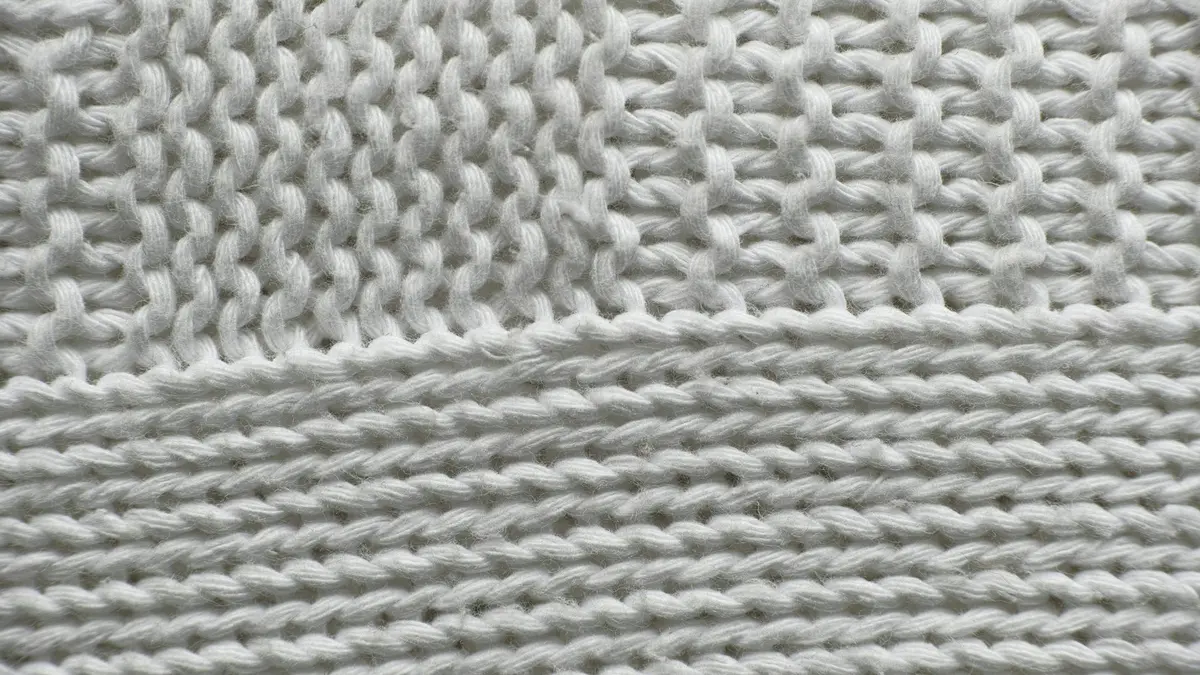
Knitted fabrics are formed from interconnected yarn loops. This looped geometry generally gives them greater extensibility and conformability than conventional woven fabrics. Depending on yarn selection and stitch construction, knitted structures can also provide softness, resilience, air permeability and useful fluid-handling capacity.
Medical knitted textiles are used where close fit or controlled stretch is important. Typical products include bandages, compression hosiery, braces, orthopedic supports, wound-contact materials and selected implantable structures. Both weft knitting and warp knitting are used, while spacer knitting and multiaxial warp knitting offer additional design options.
Compression Bandages and Pressure Garments
Compression bandages and pressure garments commonly use elastane-containing yarn systems combined with other fibers that provide strength, comfort or moisture management. The product is typically dimensioned smaller than the relevant body measurement so that extension during wear develops pressure at the fabric-to-skin interface.
Compression performance is not determined by stretch alone. Fabric stiffness, elastic recovery, stress relaxation, garment construction, body shape and fit all influence the pressure delivered over time. These products are used in clinical settings involving venous disorders, chronic venous ulcers and scar-management programs, with selection and use guided by qualified healthcare professionals.
Warp-knitted and weft-knitted constructions are widely applicable to compression articles. Multiaxial warp-knitted structures can add directional reinforcement, while spacer-knit constructions may provide cushioning, airflow and a more three-dimensional contact surface where these features are needed.
Knitted Wound-Dressing Materials
Knitted structures can be useful in wound-care products because they flex with body contours and can accommodate movement. Their loop structure can be engineered for open area, thickness, absorbency and softness, helping designers create layers that manage fluid while remaining comfortable against sensitive skin.
Spacer-knitted fabrics contain two outer textile faces connected by pile or spacer yarns. The resulting three-dimensional structure can provide permeability, cushioning and thermal insulation. In wound-care concepts, spacer layers may be designed to support fluid transfer away from the wound-facing side, although actual performance depends on fiber type, finishing, layer arrangement and the complete dressing system.
Polyester spacer constructions have been investigated for exuding-wound applications and are also relevant to compression products, vascular-textile development and pressure-sore management. Knitted gauze is another construction under consideration alongside conventional woven gauze, particularly where flexibility and liquid uptake are desired.
Knitted Implant Structures
Knitted implant textiles are used when a flexible and compliant structure is required. Artificial blood vessels, reinforcement layers and some stent-related textile components can use knitted geometry because the loops allow controlled radial or longitudinal deformation.
Vascular graft design requires suitable mechanical behavior, durability and biological compatibility with the intended anatomical location. Polyester knitted fabrics have been used as reinforcement within polyurethane graft concepts, while polyester and polyester-elastane constructions can be engineered to combine elasticity with tensile support.
The suitability of a knitted graft for a particular vessel diameter is a design-specific question. Diameter, wall thickness, porosity, crimp, yarn properties and clinical requirements must all be evaluated together; no single fabric structure is universally suitable for every vascular application.
Woven Textile Structures
Woven fabrics are made by interlacing warp and weft yarns. Their organized yarn geometry usually provides good dimensional stability, controlled construction density and structural integrity. Woven textiles are therefore valuable where strength, repeatable geometry and limited extension are more important than high stretch.
Woven medical products include hospital bedding, protective clothing, gauze, wound-dressing components and hygiene materials. More specialized woven structures are also used as tissue-engineering scaffolds, hydrogel reinforcements and implantable textile forms. Two-dimensional fabrics offer simple and stable constructions, while three-dimensional woven architectures can create thickness, internal channels or spatial support.
Woven Artificial Blood Vessels
Woven vascular textiles are particularly relevant to larger-diameter graft applications. Polyester, including polyethylene terephthalate (PET), is commonly considered because it can be formed into stable tubular structures with controlled yarn density and porosity.
Fabric geometry influences surface texture, pore characteristics and the way cells or biological fluids interact with a material surface. Changes in weft density can alter the surface profile and available pore space, which may affect cell adhesion and proliferation in laboratory studies. Such outcomes depend on the specific material, fabric design, surface treatment and test method.
Some research has examined small pore dimensions, including pores below 20 micrometres, in relation to endothelialization. These findings should be treated as study-specific design observations rather than a universal pore-size rule for vascular grafts.
Woven Vascular Grafts
Woven vascular grafts can offer high tensile strength, dimensional stability and comparatively low porosity. These characteristics are relevant in high-flow vessels and mechanically demanding locations, including aortic applications, where the graft must maintain its geometry under pulsatile loading.
Tubular weaving enables seamless woven graft production. Textured polyester yarns may be used to introduce bulk, compliance or surface characteristics while maintaining a continuous tubular construction. The final performance of a graft depends on the complete device design, including textile architecture, sealing or coating systems, surgical handling and biological response.
Clinical performance must be assessed through evidence for the specific device and indication. A general description of woven construction should not be interpreted as a prediction of clinical outcome for every woven graft.
Woven Dressings for Wound Care
Woven gauze is a longstanding wound-dressing material. Its open woven construction can provide handling strength, air access and absorbency, depending on yarn type, thread density and finishing. Woven structures remain relevant in commercial dressing products, either as gauze itself or as part of a multilayer dressing assembly.
For wound-care sourcing, construction details such as linting behavior, absorbency, softness, strength when wet and sterilization compatibility are often as important as whether the material is simply classified as woven.
Nonwoven Medical Textile Structures
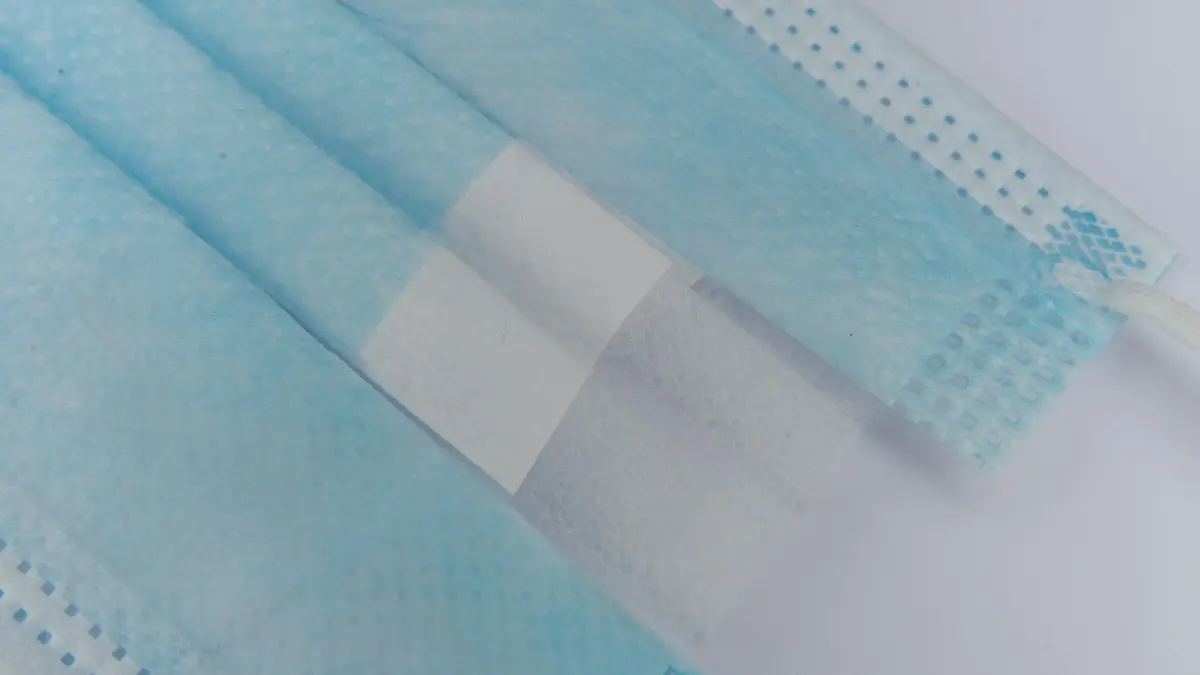
Nonwovens are fiber-web structures made without conventional yarn interlacing or loop formation. They are central to many single-use medical and hygiene products because they can be produced efficiently in lightweight, flexible and application-specific forms.
Source: Unsplash
Medical nonwovens are used in masks, gowns, drapes, pads, filters, wound dressings and hygiene articles. Their properties depend on fiber composition, web formation, bonding technique, basis weight and finishing. They may provide absorbency, breathability, liquid resistance or filtration performance, although their structural strength can be lower than that of yarn-based woven or knitted fabrics unless reinforced or engineered through bonding and multilayer design.
Hydroentangled Spunlace Nonwovens
Spunlace, also called hydroentangled nonwoven, is produced by directing high-speed water jets onto a loose fiber web. The jets entangle fibers and consolidate the web without using a conventional woven or knitted structure.
Spunlace materials are used in wound-care articles, surgical fabrics, baby-care products and sanitary products. They are often selected for softness, drape and textile-like hand. Water use is an important production consideration because hydroentanglement requires substantial water handling, filtration and recycling capability.
Spun-Laid Nonwoven Materials
Spun-laid webs are produced by forming fibers directly from polymer melt or solution processes and laying them into a web. They can provide relatively uniform structures and consistent mechanical behavior when process conditions are carefully controlled.
Calendaring may be used to consolidate or finish spun-laid materials. This process can reduce bulk and alter surface smoothness. Stronger calendaring conditions may reduce softness, and excessive thermal exposure can affect pore structure and permeability.
Spunbond Nonwoven Fabrics
Spunbond fabrics are widely used in medical, baby-care, feminine-hygiene and general hygiene products. They are valued for production efficiency, smooth surfaces, low mass and useful breathability. Their porosity and surface design can influence moisture transport and wearer comfort.
Representative uses include surgical mask outer layers, wound-dressing components, diaper layers and feminine-hygiene articles. In multilayer products, spunbond often provides support, abrasion resistance and handling strength rather than serving as the principal filtration layer.
Meltblown Nonwoven Layers
Meltblown webs are made from very fine fibers, creating a structure with small pores and a high surface area. These characteristics make meltblown layers particularly important in filtration applications, including protective medical mask constructions.
Compared with many spunbond materials, meltblown layers generally have lower air permeability because of their finer fiber network. Their thinness and softness can also be useful in hygiene-product components, such as diaper and napkin layers, when combined with other materials that provide strength or comfort.
Airlaid Absorbent Nonwovens
Airlaid nonwovens are dry-formed fiber structures designed for absorbency and liquid transfer. They are commonly used as absorbent cores or core components in diapers and feminine-hygiene products.
Pore size and density affect how liquid enters, spreads and remains within an airlaid structure. Smaller pores may support more even moisture distribution and influence rewetting behavior, while larger pores may increase total liquid-storage capacity. The preferred balance depends on the product design and intended use.
Thermally Bonded Nonwovens
Thermal bonding consolidates a fiber web through controlled heat and pressure. Metal calender rollers may be used to create bonding points, smooth the web or adjust thickness and surface character.
Thermally bonded materials are used as top-sheet or back-sheet layers in disposable products. Typical applications include wipes, breast pads, diapers, sanitary napkins and surgical apparel. Bond pattern, fiber melting behavior and pressure settings determine the final balance of softness, strength and permeability.
Composite Nonwoven Constructions
Composite nonwovens combine layers, fibers or bonding technologies to deliver properties that a single web may not provide. A composite may be designed to balance absorbency, breathability, stretch, tensile strength, liquid resistance and barrier performance.
Hydroentangled composites can incorporate cotton-containing components with spunbond or meltblown layers. In other systems, spunbond-meltblown-spunbond (SMS) arrangements use strong spunbond outer layers around a fine-fiber meltblown layer. Related multilayer structures can include additional spunbond or meltblown layers according to the required barrier and durability level.
The microporous meltblown layer is commonly responsible for much of the filtration and barrier function, while spunbond layers provide support, handling strength and resistance to surface damage. These composites are used in medical disposables and hygiene cover materials, including protective apparel and absorbent-product layers.
Braided Textile Structures
Braids are narrow textile structures produced by diagonally interlacing three or more yarns or threads. They may be flat, tubular or solid, and their braid angle, yarn count and material selection can be adjusted to control flexibility, coverage and strength.
Medical braid applications include sutures, vascular grafts, ligament-repair devices, orthopedic implants, hernia meshes, catheter reinforcements and stent-related structures. Tubular braids can expand or contract in diameter, while flat braids can provide flexible reinforcement or attachment features.
Braided constructions are valued for their configurable mechanical response and structural stability. For implantable devices, material biocompatibility, fatigue resistance, sterilization compatibility and interaction with surrounding tissue are critical considerations alongside braid geometry.
Summary
The fabrics used in medical textiles range from simple bandages and disposable hygiene layers to highly engineered implantable devices. Knitted fabrics are selected where stretch and conformability are required; woven fabrics where stable geometry and strength are important; nonwovens where efficient, lightweight disposable layers are needed; composites where multiple functions must be combined; and braids where narrow, flexible reinforcement is required.
Fabric selection should begin with the intended function: comfort, protection, fluid handling, filtration, support, controlled pressure or mechanical durability. When these requirements are translated into appropriate fiber, structure and finishing choices, medical textiles can support patient safety, care efficiency, recovery processes and healthcare functionality.