How Should You Select Geotextile Fabric for Soil Stabilization, Drainage, and Erosion Control?
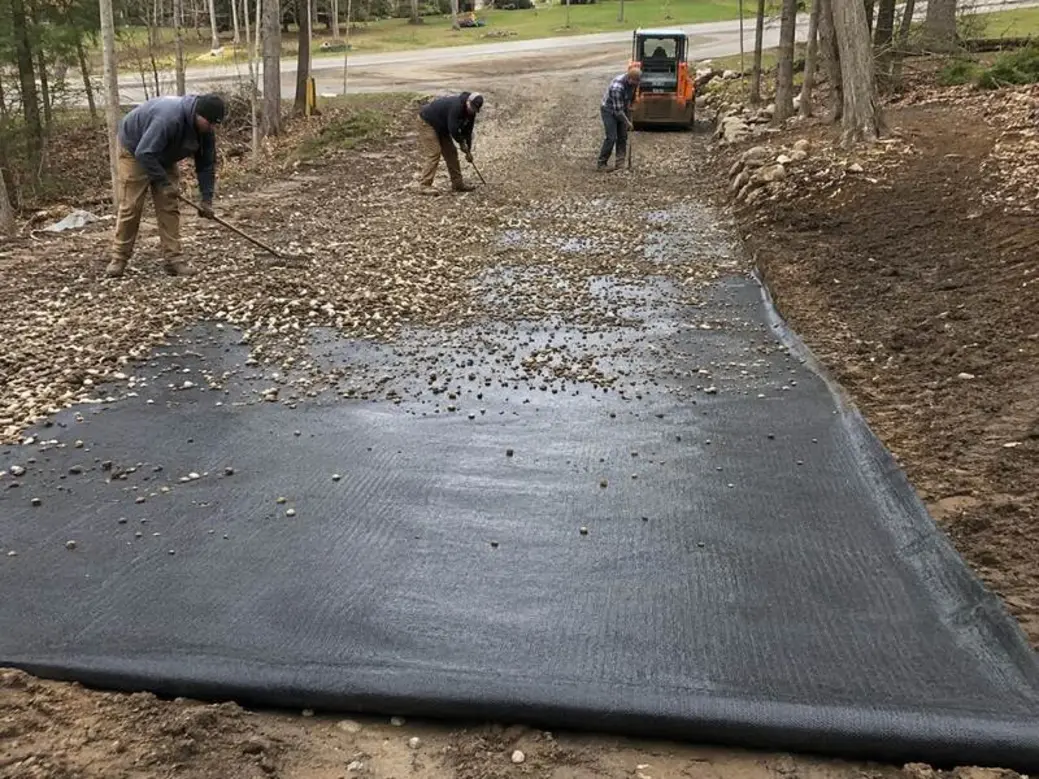
Table of Contents
Select geotextile fabric by first identifying the job it must perform—not by choosing the heaviest roll or the product marketed simply as landscape fabric. For a soft subgrade beneath a driveway, access road, or heavily loaded aggregate base, a woven geotextile is often the starting point because reinforcement and separation are central needs. For a French drain, drain rock, riprap, or a site where water must pass while fine soil stays in place, a permeable nonwoven geotextile is usually the better fit.
That is the core of effective geotextile fabric selection: match the fabric to soil, aggregate, water movement, loading, and installation exposure. One product cannot automatically solve every ground problem. A fabric that keeps aggregate from sinking into weak soil may not provide the flow needed around a drain; a fabric that filters well around drain stone may not provide enough reinforcement for a loaded pavement section.
Start with the function, not the product name
Geotextiles are engineered permeable textiles used between soil, aggregate, rock, or other construction materials. Their key functions can overlap, but one normally drives the selection.
Separation
Separation keeps unlike layers from mixing. For example, it can keep soft subgrade soil from pumping upward into a gravel base, or keep drain rock from becoming contaminated by surrounding soil. Separation is useful under driveways, paths, patios, drainage trenches, and riprap.
Reinforcement and stabilization
Reinforcement helps distribute loads and improve performance over weak or wet ground. This is the main reason to consider a woven geotextile beneath aggregate for a driveway, parking area, road, or construction access route. Its tensile behavior can help bridge weaker subgrade and limit aggregate loss into the soil.
A Reddit discussion about asphalt-related work makes the important distinction that a geotextile specified for soil stabilization concerns the subgrade and is not automatically appropriate for a different use case. That caution is sound: “stabilization fabric” should describe a site function, not become a universal product label.
Filtration
Filtration allows water to pass through while retaining the soil particles that would otherwise migrate into aggregate or drainage media. It is essential when flowing water could carry fines into a drain trench, behind a retaining wall, or below riprap.
Drainage
Drainage concerns how readily water can move through the fabric and into, along, or out of the system. In most drainage applications, a nonwoven geotextile provides the permeability and conformability needed around stone and pipe. The fabric is a filter layer; it is not a substitute for a properly sloped outlet, suitable drainage aggregate, or correctly sized pipe.
Erosion control and protection
An erosion control fabric may separate soil from rock armor, filter runoff, protect a liner, or support a temporary erosion-control system. The right product depends on whether the principal force is sheet flow, channel flow, wave action, rain splash, or soil movement on a slope. A geotextile alone does not stabilize an actively failing slope or replace site drainage and grading.
Choose woven geotextile when load support is the priority
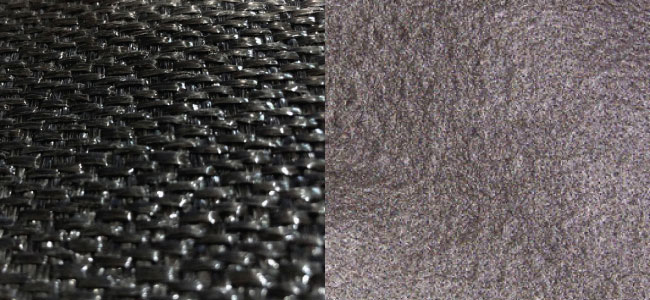
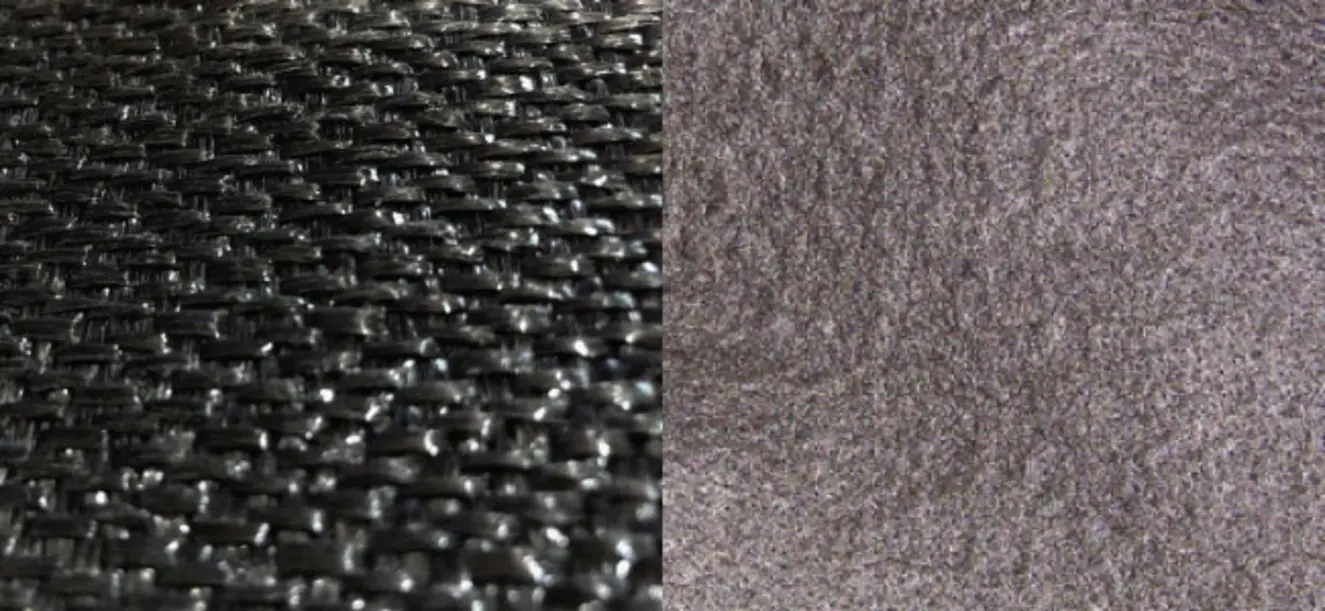
Woven geotextiles are made by weaving synthetic tapes, yarns, or filaments into an ordered structure. Many commonly used woven products have high tensile strength, relatively low elongation, and lower water permeability than typical nonwovens. These traits make them especially useful where aggregate must remain separated from weak soil while supporting repeated or substantial loads.
Typical uses include:
- Gravel driveways and access roads over soft subgrade
- Parking and pavement base construction
- Aggregate pads and working platforms
- Road and rail-related separation and reinforcement
- Some embankment and structural earthwork applications
For a driveway over soft clay or wet, yielding soil, the fabric should be selected for stabilization and separation, then paired with an adequate aggregate section and sound drainage plan. Installing a woven fabric does not mean the base can be made arbitrarily thin. Water still needs a route away from the pavement structure.
The usual tradeoff is drainage. Many slit-film woven fabrics have limited flow compared with needle-punched nonwovens. If water must freely cross the fabric to reach the subsoil or a drainage layer, confirm the specific product’s hydraulic properties rather than assuming every woven fabric behaves the same way. Some woven monofilament and specialty high-performance products are designed to provide both strength and more effective filtration or flow, but they must be selected by documented project requirements.
Choose nonwoven geotextile when water movement and filtration matter most
Nonwoven geotextiles are typically made by bonding synthetic fibers, commonly through needle punching. They have a felt-like appearance, conform more easily to irregular ground, and generally provide stronger filtration and drainage performance than conventional woven stabilization fabrics.
Use a nonwoven geotextile when the project needs to keep soil from entering a drainage layer while allowing water through. Common examples include:
- Wrapping or lining French drains and drainage trenches
- Separating soil from drain rock behind retaining walls
- Under riprap on slopes, shorelines, channels, or drainage swales
- Cushioning and protecting certain liners or membranes
- Separating soil and aggregate where permeability is important
Source: geosyntheticsmagazine
For a French drain, the goal is not merely to wrap every component tightly in fabric. The system must still allow water to enter the stone, move to the pipe, and discharge at a suitable outlet. A nonwoven filter fabric is commonly used to limit soil intrusion into the drainage aggregate, but its pore structure and flow performance must suit the surrounding soil. Very fine or difficult soils may need a project-specific filtration design rather than an off-the-shelf choice based only on fabric weight.
Do not treat landscape fabric and engineered geotextile as interchangeable
“Landscape fabric” is a retail label, not a complete engineering specification. Some landscape products are geotextiles and may be appropriate for light-duty separation or landscaping drainage. Others are lightweight weed barriers designed mainly to suppress weeds in decorative beds. Their durability, puncture resistance, UV resistance, permeability, and load capacity may be unsuitable below driveways, beneath thick stone, or in drainage systems expected to perform for years.
A supplied Reddit discussion notes that landscape fabric is a geotextile category with origins associated with erosion-control work, but that observation should not be read as proof that every retail weed barrier performs like a civil-engineering geotextile. That user discussion is here. Product naming is less important than the manufacturer’s documented properties and the demands of the installation.
For planted beds, also consider the maintenance reality. Soil, mulch, roots, and organic debris can accumulate above fabric over time. A weed barrier may complicate planting, division, and renovation. In contrast, under aggregate or drainage stone, separation and filtration can be the intended long-term functions.
Evaluate the site before choosing a roll
A reliable selection process begins with five questions.
1. What is the native soil like?
Soft, saturated, silty, clayey, or easily disturbed soils increase the importance of separation, filtration, and stabilization. Coarse, well-drained soils may need less reinforcement but can still require a filter layer to prevent aggregate migration. If soil conditions are uncertain or the work supports vehicles, a building-related feature, or critical drainage, obtain site-specific engineering advice.
2. Is water expected to cross the fabric?
If yes, prioritize hydraulic performance and filtration compatibility. This is common around drains, behind walls, under riprap, and where rainfall must infiltrate through aggregate. Avoid assuming that a strong fabric automatically drains well.
If the fabric is below a loaded aggregate base and water will be managed by surface grading, edge drainage, or another drainage layer, reinforcement may be the governing need. Even then, do not create a basin that traps water within the base.
3. What loads will the surface carry?
Foot traffic, garden paths, passenger vehicles, delivery trucks, construction equipment, and repeated turning loads place very different demands on the system. Heavier or repetitive loading over weak ground generally moves the decision toward engineered woven stabilization products or a designed composite system.
4. What could damage the fabric during installation?
Angular stone, rough subgrade, deep ruts, equipment traffic, and exposed edges can puncture or tear fabric. Consider puncture and survivability needs, not just tensile strength or fabric weight. A fabric that performs well in the ground can fail if it is dragged across sharp rock or driven over before protective aggregate cover is placed.
5. How will the edges and overlaps be handled?
Fabric must cover the intended area, overlap according to the product instructions and site conditions, and be held in position while aggregate or rock is placed. Wrinkles, gaps, damaged sections, and exposed edges can create pathways for soil mixing. On slopes and in flowing-water applications, anchoring and termination details are as important as the fabric type.
A practical selection path
For a soft-soil driveway or aggregate pad, begin with a woven soil stabilization fabric designed for separation and reinforcement. Confirm that the planned aggregate depth, compaction method, and drainage strategy suit the expected traffic.
For a French drain, drain-rock trench, retaining-wall drainage zone, or riprap underlayment, begin with a needle-punched nonwoven geotextile selected for filtration, flow, and installation survivability.
For erosion control, first identify the erosion mechanism. Use nonwoven filter fabric below riprap where water must pass without washing soil into the stone. For vegetated slopes or temporary exposed soil, the needed product may instead be an erosion-control blanket, turf reinforcement mat, or another system designed for the expected runoff and vegetation plan.
For decorative planting beds, do not automatically specify construction-grade geotextile. Decide whether weed suppression, soil separation, drainage, or a hardscape underlayment is actually needed. Mulch management, plant maintenance, and edging often matter as much as the fabric itself.
Avoid the common selection mistakes
The biggest mistake is choosing fabric by appearance: plastic-looking woven fabric for every project, or fuzzy nonwoven fabric for every project. Another is choosing solely by ounces, thickness, or price. Those descriptions do not tell you whether the fabric has suitable strength, permeability, filtration behavior, puncture resistance, or UV durability for the application.
Also avoid using fabric to compensate for unresolved site problems. A geotextile cannot correct poor grading, eliminate the need for a drainage outlet, turn unstable soil into competent structural support, or stop erosion caused by concentrated water discharged onto an unprotected slope.
The best geotextile is therefore the one whose documented performance matches the dominant site need. Choose woven fabric when load distribution and subgrade separation lead the design; choose nonwoven fabric when filtration, drainage, and conformity lead it; and specify a specialized or combined system when the project genuinely requires both high strength and controlled water flow.
References
- Woven vs Nonwoven Geotextile Fabric | Choosing the Correct Geotextile for Your Project. youtube.com. https://www.youtube.com/watch?v=v8cqR6nXjXs
- Woven vs Non Woven Geotextile Fabric: What’s The Difference?. palmetto-industries.com. https://www.palmetto-industries.com/woven-vs-non-woven-geotextile-fabric
- Types of Geotextiles: 11 Types of Geotextile Fabric Explained. palmetto-industries.com. https://www.palmetto-industries.com/types-of-geotextiles
- Understanding Woven and Nonwoven Geotextiles - White Cap Blog. blog.whitecap.com. https://blog.whitecap.com/2025/01/10/understanding-woven-and-nonwoven-geotextiles
- Nonwoven Geotextile Drainage Fabric | Uses, Specs, Pricing. erosioncontrol-products.com. https://www.erosioncontrol-products.com/nonwovengeotextile.html
- The Importance of Selecting and Using the Correct Geotextile Fabric. ejprescott.com. https://www.ejprescott.com/blog/the-importance-of-selecting-and-using-the-correct-geotextile-fabric
- The Ultimate Guide to Geotextiles | Amster Howard. amsterhoward.com. https://amsterhoward.com/wp-content/uploads/The-Ultimate-Guide-to-Geotextiles-Mainline-Materials.pdf
- The Difference Between Woven And Non-woven Geotextiles. blog.alliancegator.com. https://blog.alliancegator.com/the-difference-between-woven-and-non-woven-geotextiles