How Much Twist Should a Handspun Singles Yarn Have to Limit Pilling Without Causing Bias?
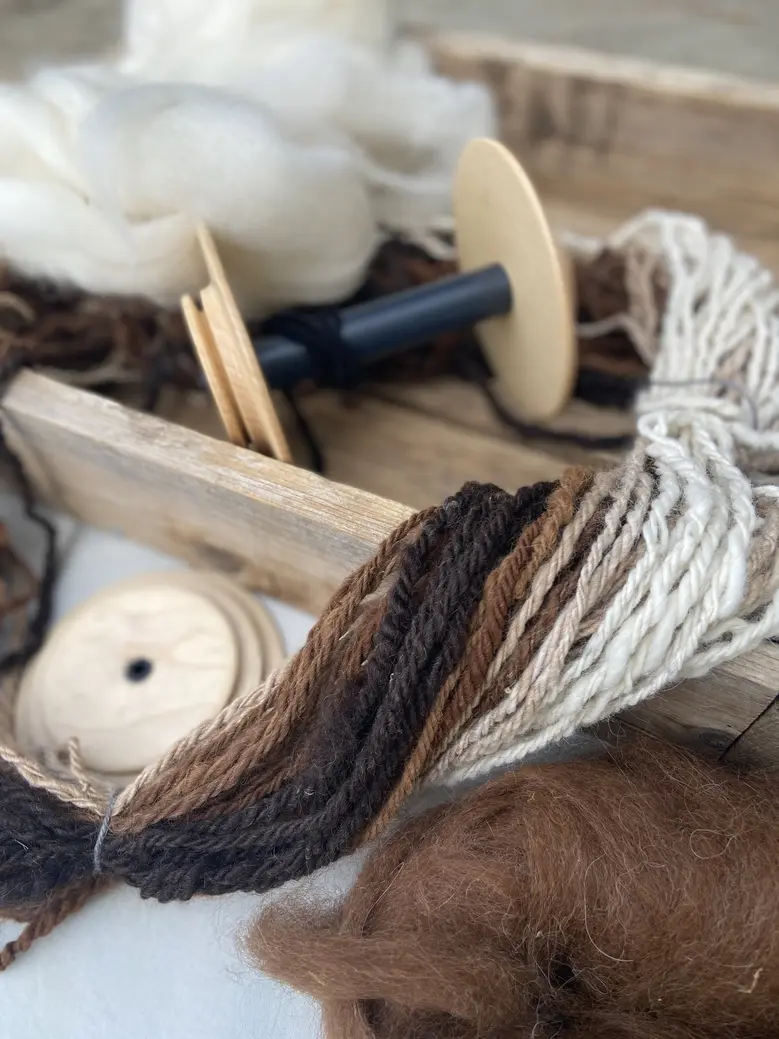
Table of Contents
There is no single twist count that will make every handspun singles yarn both pill-resistant and completely free of bias. For most projects, the practical target is enough handspun singles yarn twist to hold the fibers securely, but not so much that a relaxed sample loops, kinks, or drives a knitted swatch noticeably diagonal.
The key limitation is that a true singles yarn retains some twist energy by nature. In a plied yarn, twist in the singles is countered by twist in the opposite direction during plying. A singles yarn has no opposing ply twist, so it cannot be balanced in quite the same way. Instead of trying to make a singles yarn perfectly inert, spin and test a small sample that has the durability your project needs and only as much liveliness as the finished fabric can tolerate.
Start with the fiber, not a universal twist number
Twist binds drafted fibers together. With too little twist, fibers can pull out more readily during wear, making the yarn weaker and increasing the opportunity for fuzz and pills to develop. This concern is especially relevant with short staple fiber: fibers have less length available to overlap and grip one another.
A handspinning discussion about twist notes that less-twisted yarns can be weaker and more prone to pilling, particularly when spun from shorter-staple fiber. That is useful practical guidance, but it is not a fixed prescription: fiber preparation, yarn thickness, drafting method, and the project’s abrasion level all change the result.
Use these tendencies as a starting point:
- Short-staple fiber usually needs a firmer twist than long-staple fiber at the same yarn size because the individual fibers have less overlap.
- Fine singles generally need more twists per inch than thick singles to achieve comparable cohesion. Twist should therefore be judged relative to yarn diameter, not as one number for every yarn.
- Soft, lofty preparations can tolerate less twist when softness and halo are priorities, but they may pill sooner in high-friction use.
- Smooth, tightly organized fiber preparations often support a more durable yarn, although too much twist can make the yarn hard, wiry, and energetic.
- High-abrasion projects need more durability than occasional-wear projects. Socks, mittens, cuffs, underarm areas, and bag straps ask more of a yarn than a drapey scarf or a decorative shawl.
A singles yarn for a gently worn shawl can reasonably prioritize softness and bloom. A singles yarn intended for a sweater sleeve or mitten should generally prioritize firmer fiber control, even if that means accepting some residual twist energy.
Why more twist can reduce pilling—and create bias
Pilling begins when loose surface fibers are repeatedly rubbed, lifted from the yarn, and entangled into small balls. Twist does not eliminate pilling, but it helps hold fibers inside the yarn structure. A low-twist singles yarn leaves more fibers available to migrate outward, especially after abrasion.
However, every added turn also stores more rotational energy in the yarn. When the yarn is released from tension, it may try to rotate back on itself. In knitted fabric, that energy can contribute to skewing or bias: rows and columns may drift diagonally rather than sitting squarely.
This is why strength and stability are a trade-off rather than a choice between “good” and “bad” twist. The question is not whether the yarn has twist energy. The question is whether it has more twist energy than the structure and intended use of the fabric can comfortably absorb.
Knitting construction matters here. Stockinette fabric is especially useful for revealing bias because it has a directional structure and little resistance to distortion. Texture, ribbing, stranded colorwork, seams, and stitch patterns can alter how much skew is visible, but they should not be used to hide an unsuitable yarn before you have tested it.
Spin a sample yarn before committing to the full fiber supply
The most reliable method is to make a small, intentional sample rather than choosing twist by appearance alone.
1. Define the yarn’s job
Write down the project and its most important requirement. For example:
- A next-to-skin cowl may favor softness, drape, and a mild halo.
- A sweater yarn may need moderate durability and fabric stability.
- A hard-wearing accessory may need a firmer yarn and may be a poor match for a soft, low-twist singles construction.
If pilling resistance and no-bias knitting are both critical, consider whether a plied yarn would better serve the project. That is not a failure of singles yarn; it is simply a recognition that plying provides a way to counter twist energy.
2. Spin several short samples, changing only twist
Spin a few lengths from the same fiber preparation and aim for the same thickness in each. Give one sample slightly less twist, one a moderate amount, and one somewhat more. Avoid changing draft, yarn diameter, and fiber preparation at the same time, or you will not know which change produced the difference.
Do not rely only on what the yarn looks like under tension at the wheel or spindle. Yarn often appears calmer while it is being held taut than it does after it has relaxed.
3. Let each sample relax
Make a short skein or length of each sample and allow it to hang freely. A yarn with excessive stored energy may curl around itself, form tight loops, or kink readily. A very low-twist yarn may look limp, open, or poorly consolidated, with fibers that seem only loosely held together.
Source: ashford.co.nz
This observation is a screening tool, not a final verdict. A singles yarn may show some twist response and still make suitable fabric. What matters is whether the response is mild enough for the intended construction.
4. Knit swatches in the actual stitch pattern
Knit each sample into a small swatch, beginning with plain stockinette if bias is your chief concern. If your project uses another main stitch pattern, make a second swatch in that pattern as well.
Lay the swatches flat without stretching them. Look for these signs:
- Do the columns lean consistently to one side?
- Do the top and bottom edges rotate instead of lying roughly parallel?
- Does the swatch resist being squared after gentle handling?
- Does the fabric feel firm enough for its intended use?
- Are fibers already lifting prominently from the surface?
A small amount of movement at the edges may be acceptable in a relaxed accessory. Clear diagonal distortion in the body of the swatch is a sign to reduce twist, change the yarn construction, or choose a stitch pattern and project that better suit energetic singles.
5. Finish the swatches as you will finish the project
Wash or wet-finish the samples in the way appropriate for the fiber and project. Finishing can allow fibers to settle and can change the yarn’s feel and appearance. It may soften the expression of twist energy, but it should not be treated as a guaranteed cure for a strongly overtwisted singles yarn.
Check the swatches again after they are dry. Compare softness, fabric angle, surface fuzz, and firmness. This is the point at which the best sample is often obvious.
Choose the lowest twist that passes your durability test
For a singles yarn, a useful working rule is to select the lowest twist level that still produces a coherent yarn and a fabric suited to its intended wear. Lower twist may improve loft and softness, while higher twist generally improves fiber control. The right answer is the point where those benefits meet without unacceptable skew.
If your moderate-twist sample holds together, produces a stable swatch, and does not show severe surface fuzz after handling, it is probably a better choice than a tighter sample that pulls the fabric strongly off-grain. Conversely, if the softest sample looks open, sheds fibers readily, or feels too fragile for the project, add twist even if the yarn becomes less lofty.
Common mistakes when judging singles twist
Assuming a skein that hangs straight is fully balanced
A relaxed, straight-hanging skein is a useful sign for plied yarns, where opposite twist directions can be balanced. But singles yarn behaves differently because it retains the original spinning twist. Use the hanging test to identify extreme energy, then confirm the decision with knitted fabric.
Testing only the yarn and not the fabric
Yarn can look attractive in a skein yet bias after it is knitted. A small stockinette swatch is usually more informative than visual inspection alone.
Treating pilling as a twist-only problem
Twist affects fiber security, but pilling also depends on fiber characteristics, yarn structure, abrasion, garment fit, and use. A yarn spun for softness may pill more than a firm yarn even when it has adequate twist for structural integrity.
Overcorrecting with excessive twist
Adding twist can solve an underbound, fragile yarn, but it can also create a hard yarn with strong torque. If you must add a large amount of twist before a singles yarn feels durable enough, consider a different fiber preparation, a thicker yarn, a less abrasive project, or a plied construction.
The practical answer
Spin singles with enough twist to keep the chosen fiber securely integrated, giving short-staple fiber and high-wear projects more attention to durability. Then stop before the yarn’s twist energy causes unacceptable fabric skew. Because every singles yarn retains some energy, the goal is not theoretical perfect balance; it is a swatch that meets your project’s standards for strength, surface wear, hand, and bias after finishing.
A deliberate sample sequence—low, moderate, and firmer twist; relaxed yarn checks; and finished knitted swatches—will tell you far more than a universal twists-per-inch target can.
References
- Understanding Twist in Handspun Yarn | The Fiber Faerie. thefiberfaerie.com. https://thefiberfaerie.com/blogs/news/understanding-twist-how-much-and-why-it-matters
- Finding Balance | Spin Off. spinoffmagazine.com. https://spinoffmagazine.com/finding-balance
- Achieving balanced plys in handspun yarn as a new spinner. facebook.com. https://www.facebook.com/groups/143233812429678/posts/9161282253958077
- what do I want the handspun to look like? - Wool n’ Spinning. welfordpurls.com. https://welfordpurls.com/2015/04/28/what-do-i-want-the-handspun-to-look-like
- Balanced ply in hand spun yarn. beechwoodcrafts.com. https://beechwoodcrafts.com/2020/12/07/balanced-ply-in-hand-spun-yarn
- Advice on finding the right amount of twist for my singles? - Reddit. reddit.com. https://www.reddit.com/r/Handspinning/comments/11lhy9e/advice_on_finding_the_right_amount_of_twist_for
- How to achieve a tighter twist in handspun yarn - Facebook. facebook.com. https://www.facebook.com/groups/143233812429678/posts/1878651698887872
- How to keep twists in handspun singles yarn - Facebook. facebook.com. https://www.facebook.com/groups/509886674408793/posts/1221329043264549