How Can You Identify Fabric at a Thrift Store Without a Tag?
Table of Contents
You can often identify fabric without a tag well enough to decide whether it is worth buying and how cautiously to use it. Start by identifying its construction—woven, knit, or non-woven—then combine visual clues, hand feel, drape, stretch, wrinkle behavior, edge examination, and condition checks. Treat the result as a working assessment, not a laboratory-certified fiber content.
For thrifted fabric, the immediate goal is usually more useful than naming an exact fiber. You need to know whether a sheet, duvet cover, tablecloth, curtain, or garment has enough stability, weight, stretch, durability, and usable yardage for your project. A fabric may look like linen but be cotton or a blend; satin describes a weave, for example, rather than proving the fabric is silk. Multiple clues are more reliable than any single clue.
A sewing discussion about unidentified thrift-store textiles specifically raises sheets, duvet covers, and tablecloths as possible sources for making pants. That is a sensible use for secondhand textiles—but only after checking that the material suits the pattern and is sound enough to sew.
Begin with the project, not the fiber guess
Before trying to name the fiber, ask what the pattern requires.
A crisp, stable woven can work for a structured shirt, apron, tote, or lightweight pants. A soft fabric with fluid drape may suit a gathered skirt or blouse but may not hold a tailored shape. A stretchy knit needs a pattern designed for knit fabrics. Heavy upholstery-weight cloth may be durable but too stiff or bulky for apparel.
This approach prevents a common thrift-store mistake: buying a beautiful textile because it appears to be natural fiber, then discovering that it has the wrong behavior for the garment. Fiber content matters for care and pressing, but construction and performance often matter first for sewing.
Look closely at how the fabric is made
Hold the textile near a window or another strong light source. Look at both sides if possible.
Is it woven, knitted, or non-woven?
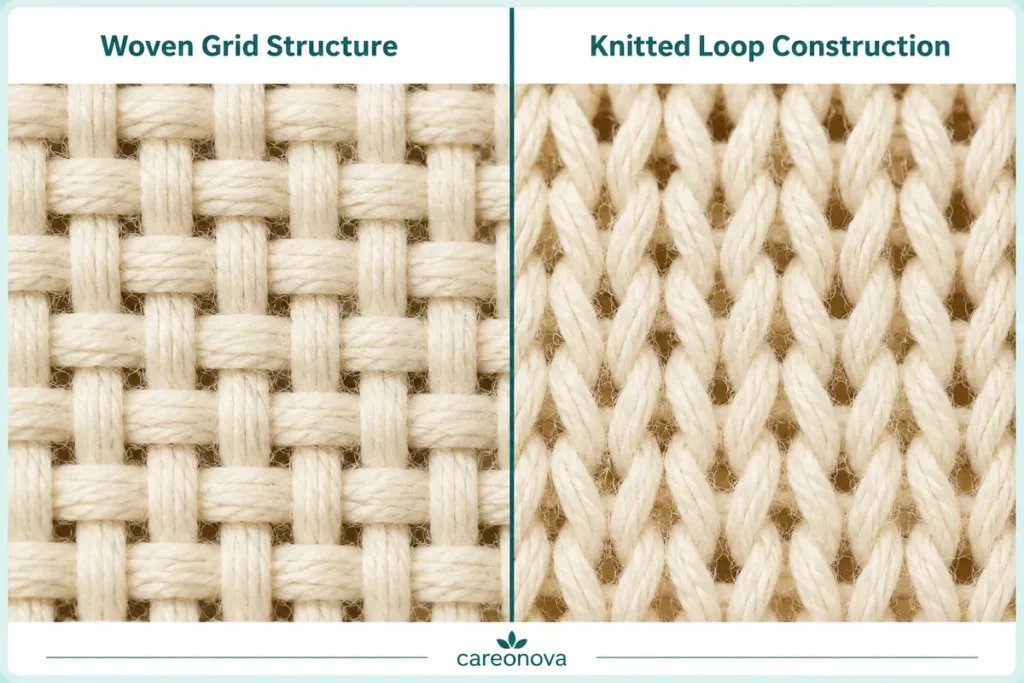
A woven fabric has yarns crossing at right angles: lengthwise warp yarns and crosswise weft yarns. It may fray at a cut edge and usually has limited stretch unless elastic fibers or a special construction are involved. Plain-woven sheets, poplin, denim, twill, many tablecloths, and many dress fabrics fall into this group.
A knit fabric is made from loops. It generally stretches more readily, especially across its width, and may curl at a cut edge. T-shirts and sweaters are familiar examples. Look for small linked loops rather than a simple over-under grid.
A non-woven fabric is made by bonding fibers rather than weaving or knitting them. Felt is a common example. It does not unravel in the same way as a woven, but it may pill, stretch out of shape, or tear differently.
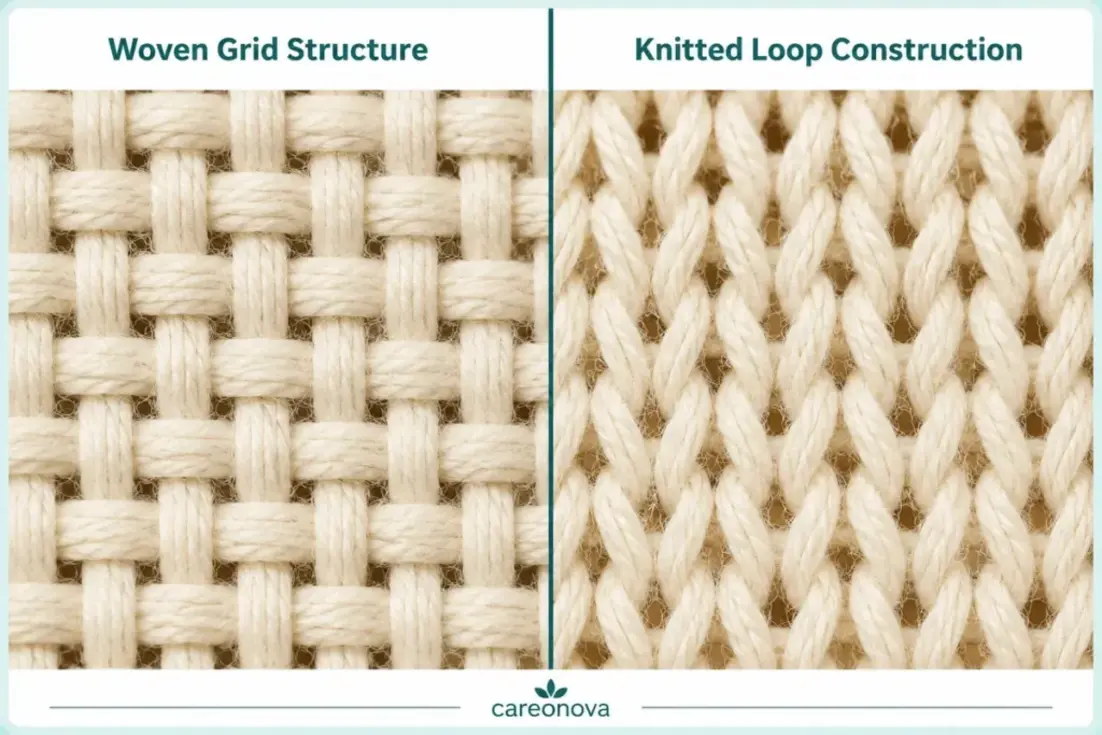
Source: careonova
Construction does not identify the fiber by itself. Cotton, polyester, wool, silk, rayon, and blends can all appear in different constructions. It does tell you what sewing behavior to expect.
Check the weave and surface
Look for visible texture and pattern:
- A plain weave has a simple over-one, under-one appearance and is common in sheets and quilting-weight cloth.
- A twill has diagonal ribs, as in denim and many chino-style fabrics.
- A satin weave has a smooth face created by longer yarn floats. It can be silk, polyester, nylon, acetate, or another fiber.
- Raised loops may indicate terry cloth, useful for towels or robes but usually unsuitable for a crisp garment pattern.
Uneven yarn thickness, small slubs, and a slightly irregular surface can occur in linen or linen-like fabrics. However, texture alone is not proof: finishes and manufactured yarns can imitate a rustic look.
Use touch and drape as clues, not verdicts
Let a section of fabric fall over your hand or hang from one corner. Notice whether it stands away from the hand, folds crisply, clings, or flows.
Cotton and linen often feel cool at first touch and can feel matte and relatively firm. Linen is commonly associated with a crisp hand and visible irregularities, while cotton often feels softer and more even. Rayon can feel soft and fluid, sometimes with a sheen. Wool is usually warm, resilient, and springy. Silk may feel smooth and fine, while many synthetics feel especially smooth, slippery, or somewhat plasticky.
Those are tendencies, not guarantees. Finishes, repeated laundering, fabric weight, yarn twist, and blending can substantially change feel. A well-washed cotton sheet may feel very soft; a polyester garment may have a convincing matte finish; and a cotton-polyester blend can combine properties of both.
A useful comparison is to handle a confirmed reference fabric you already own. Compare the mystery textile with known cotton sheeting, linen, polyester lining, wool suiting, or jersey knit under the same conditions.
Do a gentle stretch and wrinkle check in the store
Stretch a small area lightly in both directions and release it. Do not pull hard enough to distort an older textile.
A knit usually has clear mechanical stretch because of its looped structure. A woven may have a little diagonal give when pulled on the bias, but it should not behave like a knit unless it contains elastic yarns or has a stretch weave.
Next, squeeze a hidden corner in your hand briefly and release it. Cotton, linen, and rayon commonly show wrinkles more readily than polyester or nylon, which tend to resist creasing. Wool often recovers from wrinkles better than many plant-based fibers.
Again, use this only as supporting evidence. Wrinkle-resistant finishes can change the result, and heavy or tightly woven fabrics may crease differently from lightweight versions of the same fiber.
Inspect edges, seams, and the least attractive areas
The edge of a thrifted textile can reveal both construction and condition.
For flat linens, look for a selvage: the tightly finished lengthwise edge made during weaving. Some fabric selvages may carry manufacturer or fiber information, although many household textiles will not. On a garment, inspect seam allowances, hems, and inside facings for an overlooked care label, fabric stamp, or a small unexposed section.
Examine areas that receive stress or soil:
- Check folded creases, hem edges, and corners for thinning.
- Look for sun fading, especially on curtains and tablecloths.
- Look for pilling, snagged yarns, broken threads, brittle spots, or uneven fading.
- Hold pale fabric to the light to find weak areas, stains, or hidden repairs.
- Smell the item before buying. Persistent mildew or smoke odor may be difficult to remove and can affect whether the textile is practical to use.
For secondhand sheets and duvet covers, inspect the center as well as the edges. A sheet may look sound when folded but have thinning in the middle from repeated use. For a garment, remember that unpicking seams may expose faded fold lines, needle marks, or a different-colored reverse side.
Take it home before relying on water or burn testing
Avoid wet tests in a store unless the seller expressly permits them. A water-drop test can sometimes offer a broad clue: absorbent fabrics such as cotton, linen, and rayon may take in water relatively quickly, while polyester and nylon often resist wetting longer. Wool can absorb moisture while its surface initially resists wetting. Finishes, coatings, soil, and wear can make this test misleading, so it cannot confirm fiber content.
Wash or clean the item appropriately before cutting it. Secondhand sewing fabric should be cleaned before it enters your fabric stash or sewing area. If possible, use a small inconspicuous section to see whether it shrinks, bleeds, puckers, becomes limp, or changes texture. The result helps you plan seam finishes, prewashing, and care.
Reserve the fabric burn test for a tiny scrap and a controlled setting
A fabric burn test can help distinguish broad fiber groups, but it is not a definitive test for all fabrics. It is especially limited with blends, coated textiles, flame-retardant treatments, unknown finishes, and fabrics containing different fibers in warp and weft. Professional identification may use microscopy or infrared analysis, which can provide more dependable information for difficult or high-stakes cases.
Only consider a burn test at home if you can remove a tiny scrap without damaging the item and can work safely. Never burn fabric while wearing it, never burn a large piece, and do not test an unknown coated, treated, or heavily soiled textile.
If you choose to test a scrap, work outdoors or in strong ventilation on a nonflammable surface. Keep water nearby, use tweezers or tongs, keep combustibles away, and extinguish the sample fully. Avoid intentionally inhaling smoke or relying on odor as your main clue.
In broad terms, cellulosic fibers such as cotton, linen, and rayon commonly burn and leave a soft ash. Protein fibers such as wool and silk tend to resist ignition more than many cellulosics and leave a brittle dark residue. Many synthetic fibers melt and can form a hard bead. These patterns overlap, and blended fabrics can show mixed behavior. A burn test should therefore support your other observations, not overrule them.
Make the buying decision with an honest label of your own
Once you have examined the item, write down a practical description rather than claiming more certainty than you have. For example:
- “Lightweight stable plain-weave woven; likely plant-based or blend; wrinkles readily; good candidate for a loose shirt after washing.”
- “Medium-weight fluid woven with smooth surface; likely synthetic or rayon blend; test press temperature on a scrap.”
- “Stretch knit with good recovery; fiber unknown; use a knit pattern and test stitches before cutting.”
This kind of note is more useful than guessing “100% linen” from appearance alone. It guides pattern selection, pressing, needle choice, seam treatment, and laundering while leaving room for uncertainty.
The best thrift-store fabric finds are not necessarily the ones you can identify with laboratory precision. They are the ones whose construction, condition, and behavior match the project you want to make.
References
- How to Identify Any Fabric: 5 Simple Tests (2026 Guide). fibercheck.app. https://fibercheck.app/blog/fabric-identification-guide
- How Fabric Identification Works in the Textile Industry | Professional Methods Explained – FABCYCLE. fabcycle.shop. https://www.fabcycle.shop/blogs/thread-thought/part-2-how-fabric-identification-works-in-the-textile-industry
- Fabric Testing: Burn Test & Methods For Identification - SewGuide. sewguide.com. https://sewguide.com/fabric-testing-identification
- The Fabric Burn Test: Complete Guide to Fiber Identification, Safety, and Lab Testing | The Laboratory Outsourcing Network - Contract Laboratory. contractlaboratory.com. https://contractlaboratory.com?p=36374
- 7 Visual Cues to Identify Fabric Quality Instantly. anuprerna.com. https://anuprerna.com/blogs/7-visual-cues-to-identify-fabric-quality-instantly/29276999
- Textile Fiber Identification: Full Practical Guide - Textile Engineering. textileengineering.net. https://textileengineering.net/textile-fiber-identification-full-practical-guide
- How to Identify Fabric Fiber Content: Burn Test & More! – FABCYCLE. fabcycle.shop. https://www.fabcycle.shop/blogs/thread-thought/how-to-identify-fabric-fiber-content-burn-test-more
- Identification of Textile Fibers - The Textile Journal. thetextilejournal.com. https://thetextilejournal.com/identification-of-textile-fibers