How Knit Structure Affects Fabric Performance
Table of Contents
How Knit Construction Influences Fabric Properties
The effects of knit structure on fabric performance begin with the loop. Unlike woven fabrics, which are formed by interlacing warp and weft yarns, knitted fabrics are built from interconnected loops. These loops can change shape under tension, bending, compression, and movement. As a result, knits usually offer greater flexibility and stretch than most woven fabrics, but they may also have lower cover, more open spaces, and a greater risk of dimensional change.
A knitted fabric is not defined by loops alone. Its performance depends on loop length, stitch density, yarn count, fiber type, yarn twist, finishing, and whether it is made as a weft knit or warp knit. A small adjustment in loop formation can change several properties at once. For example, a longer loop can increase stretch and softness but may reduce cover and shape retention. A tighter structure may improve stability and opacity while reducing flexibility.
For this reason, knit selection should consider the whole performance balance rather than one property in isolation. A fabric designed for a close-fitting active garment, a lightweight T-shirt, a stable lining, and a warm fleece layer may all be knitted, but each requires a different structural approach.
Durability of Knitted Fabrics
Durability in knitted fabrics is not simply a matter of yarn strength. It includes the ability of the structure to extend during wear, return toward its original dimensions, resist loop damage, and retain an acceptable appearance after repeated use and laundering. A durable knit must balance flexibility with structural security.
Extensibility and Elastic Recovery
Knitted loops can deform in both the coursewise direction, across the fabric, and the walewise direction, along the fabric length. This gives many knitted fabrics multidirectional extensibility. When the fabric is stretched, loops open, rotate, and redistribute tension. Once the force is removed, the loops and yarns attempt to return to their previous configuration.
Recovery depends strongly on the resilience of the fibers and yarns. Fibers and yarns that recover well from bending and extension help the fabric regain its shape after body movement. Yarn construction also matters: a yarn that is excessively loose, bulky, or poorly balanced may allow more permanent deformation than a firmer yarn used in the same knit structure.
Single knits are often relatively extensible because they contain one primary set of loops and can move freely under tension. Double knits are generally more stable and less extensible because their structures are more compact and balanced. Warp knits also tend to provide greater stability and lower extensibility than many weft knits because the yarns are arranged in a more restrained loop formation.
Woven fabrics are commonly firmer and less elongatable than knits because their yarns are interlaced rather than looped. This does not make one construction universally better. Knits are useful when body movement, softness, or fit adaptability is important, while firmer woven structures are often selected where controlled shape and low extension are required.
Runs and Loop Failure in Weft Knits
A weft-knit fabric may run when a loop breaks or slips out of its connected loop path. Once one loop fails, adjacent loops can lose support, allowing the damage to travel through the structure. Fine, lightweight weft knits can therefore be vulnerable to runs if they are snagged or subjected to concentrated stress.
Fiber and yarn strength can reduce the likelihood of loop breakage. Stronger yarns are better able to resist damage from abrasion, snagging, and localized tension. However, run resistance is still a structural issue as well as a material issue. Open loops, long loop lengths, and very fine constructions may remain more vulnerable than compact or specially engineered structures.
The durability trade-off is clear: a highly flexible knit can offer excellent stretch and comfort, yet the same mobile loop structure may require careful yarn selection, fabric finishing, and garment design to maintain loop stability. Areas exposed to sharp edges, hardware, or frequent abrasion may need a more stable knit construction.
Appearance Characteristics of Knitted Fabrics
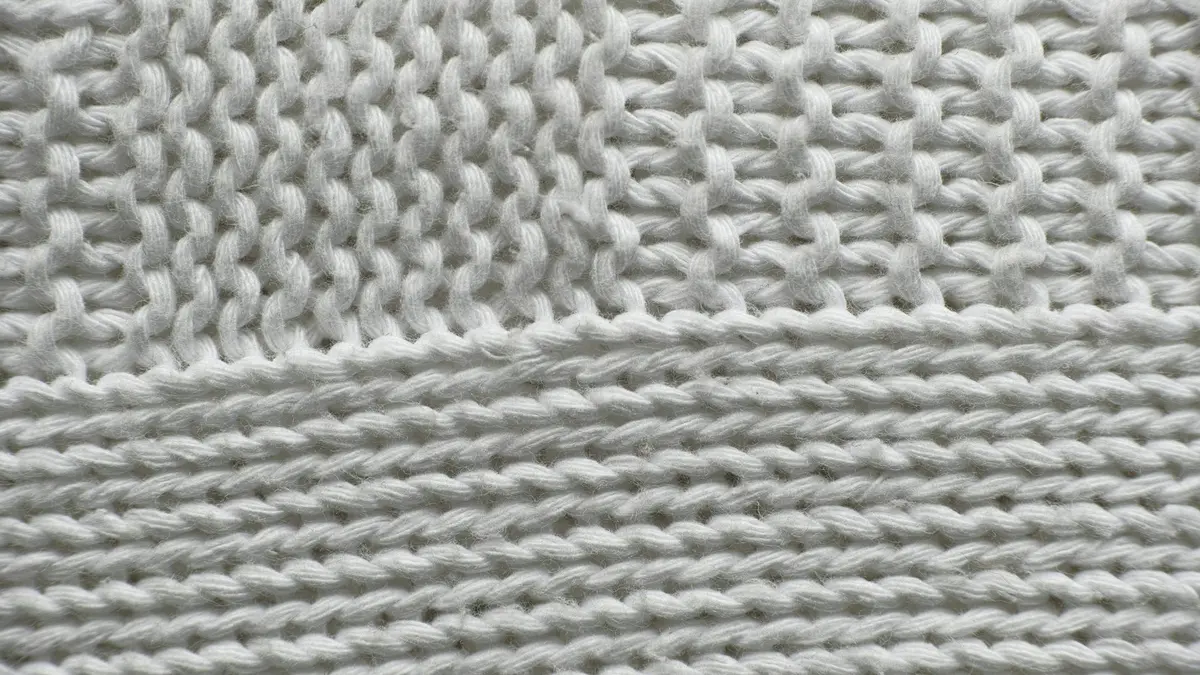
Knit construction has a major influence on appearance. Drape, surface smoothness, wrinkle behavior, dimensional change, cover, and porosity all affect how a fabric looks in a finished product. These characteristics also influence whether a knit is suitable for a fitted garment, a loose silhouette, a lingerie application, sportswear, outerwear, or a decorative textile.
Source: Unsplash
Shear Behavior and Drape
Shear is the ability of a fabric to deform when forces act diagonally across its surface. It affects how fabric falls around curves, conforms to garment shapes, and maintains a smooth appearance. Fabrics with suitable shear behavior can drape more easily, especially in designs that depend on diagonal or bias-oriented shaping.
Knitted fabrics are highly flexible and extensible, but they generally do not shear as readily as woven fabrics. Their loops tend to accommodate stress by changing loop shape and extending rather than by allowing the same degree of diagonal yarn displacement found in many woven structures. This distinction is important because stretch and drape are related but are not identical properties.
Warp knits generally resist shearing more than weft knits. Their more controlled loop arrangement gives them improved dimensional stability, but it may also limit their suitability for designs that depend on high shear deformation. Tricot, a common warp-knit construction, is typically resistant to shear and may not be the best choice for a garment intended to behave like a highly bias-responsive fabric.
When choosing a knit for a particular silhouette, designers should evaluate drape, extension, recovery, and shear together. A fabric that stretches comfortably may still resist the diagonal movement needed for a particular cut or garment shape.
Crease Resistance and Dimensional Shrinkage
Knitted fabrics commonly show good crease resistance because their looped structures allow yarns and fibers to redistribute after bending. The fabric can relax more readily than a firm, closely interlaced structure, so wrinkles may be less persistent. This characteristic contributes to the casual, soft appearance associated with many jersey, rib, and fleece fabrics.
The same structural mobility that reduces wrinkling can create dimensional stability concerns. During laundering, wet processing, drying, or handling, loops may relax into a different configuration. In relaxation shrinkage, loops can broaden, reducing fabric length while increasing width. This is why a knit may become shorter and wider after washing if it has not been adequately stabilized.
Tighter knit structures can show greater shrinkage during relaxation until the structure reaches a point where further loop contraction is restricted. At very high tightness, the fabric may resist additional contraction or develop buckling and distortion. Shrinkage behavior is therefore affected by more than fiber content; loop geometry, stitch density, finishing, and laundering conditions all play a role.
For products where fit is critical, dimensional stability should be assessed before production. Pattern allowances, preshrinking, compacting, heat setting where appropriate, and controlled finishing can help manage expected changes.
Cover Factor and Fabric Porosity
Cover describes how fully yarn occupies the fabric area. Because knitted fabrics contain spaces between loops, they commonly provide lower cover than woven fabrics made from comparable yarns. Lower cover can produce a light, breathable, and flexible fabric, but it can also increase transparency and reduce resistance to wind or snagging.
Weft knits are generally more porous than warp knits because their loop structures are often more open and mobile. Warp knits can provide a more stable and comparatively compact surface, although their porosity still depends on yarn, stitch construction, and machine settings. Raschel knitting is an example of warp knitting that can intentionally produce open, lacy, net-like, or decorative structures.
Yarn thickness is an important control for cover. Using a thicker yarn can fill more of the spaces between loops, producing a fuller appearance and reducing openness. Increasing yarn thickness may also change weight, stiffness, warmth, and drape, so it should be considered as part of the total fabric specification rather than as an isolated adjustment.
Comfort Performance of Knitted Fabrics
Comfort in knitted fabrics results from a combination of structural flexibility, air movement, heat retention, surface feel, fiber type, and yarn characteristics. A knit can feel comfortable because it follows body movement, because it traps insulating air, because it has a smooth surface, or because it manages these factors in a balanced way for the intended end use.
Source: Unsplash
Air Entrapment and Thermal Warmth
Knitted structures can entrap more air than woven structures because loops create internal spaces within the fabric. Air is a poor conductor of heat, so still air held within a textile can improve insulation. The amount of air retained depends on loop density, fabric thickness, tightness, yarn bulk, compression during wear, and the presence of additional surface structures.
Pile and napped knit surfaces create extra dead-air spaces. Fabrics such as brushed fleece can therefore provide warmth without requiring a very dense base structure. The raised fibers hold air near the surface, while the knit base maintains flexibility and stretch.
Warmth can be improved when a pile or napped surface faces the body or is protected by another clothing layer. Layering reduces air movement and helps preserve the insulating air spaces within and between garments. However, a very open knit may allow more air exchange, so a warm garment often requires an appropriate combination of bulk, cover, and layering rather than openness alone.
Softness and Fabric Hand
The flexible loop structure of knitted fabric contributes to its commonly soft and compliant hand. Loops bend and move under light pressure, allowing the fabric to conform easily to the body. This is one reason knits are widely used for next-to-skin garments, casual apparel, hosiery, activewear, and soft furnishing applications.
Construction alone does not determine softness. Fiber type, fiber fineness, yarn twist, yarn hairiness, surface finishing, and fabric weight can all increase or reduce smoothness. A fine, soft yarn in a balanced jersey may feel very different from a coarse yarn in a tight rib or an abrasive textured knit.
Tactile comfort also depends on the relationship between the fabric and the wearer. A soft surface may be desirable for underwear or sleepwear, while a firmer, more textured hand may be appropriate for outerwear or technical apparel. Selecting a knit therefore requires attention to both the physical structure and the sensory effect of the chosen fibers and yarns.
Key Takeaways for Knit Selection
Knit structure influences nearly every important aspect of fabric performance. Loop mobility gives knitted fabrics their characteristic stretch, flexibility, soft hand, and ability to accommodate movement. At the same time, that mobility can affect shape retention, shrinkage, cover, and resistance to loop damage.
The main structural differences can be summarized as follows:
- Single knits are often soft, flexible, and extensible, but may have lower dimensional stability and greater susceptibility to running.
- Double knits generally provide more stability, cover, and shape retention, with less extensibility than many single knits.
- Weft knits commonly offer high stretch and comfort, but their loops can be more vulnerable to runs and dimensional change.
- Warp knits are usually more stable, less extensible, and more resistant to shear than many weft-knit structures.
- Tricot fabrics provide a stable warp-knit surface and can be useful where controlled stretch and shear resistance are needed.
- Pile and napped knits can improve warmth by retaining dead air, while open constructions can improve ventilation and create decorative effects.
Appropriate fabric selection begins with the required end-use performance. A designer or sourcing team should consider the expected movement, fit, opacity, warmth, drape, laundering conditions, and exposure to snagging or abrasion. Understanding how the knitted structure behaves makes it easier to choose a fabric that delivers the intended appearance, comfort, and service life.