How Should You Dispose of Worn-Out Microfiber Cloths?
Table of Contents
If a microfiber cloth is merely stained, less absorbent, or too rough for delicate surfaces, do not throw it away immediately. The most practical microfiber cloth disposal route is usually to downgrade it to a less demanding, clearly labeled cleaning task. When it is torn apart, shedding heavily, permanently contaminated, or no textile-recycling program will accept it, disposal in regular trash may be the unavoidable final step.
Microfiber cloth recycling is possible in some places, but it is not something to assume. Most cleaning microfiber is made from synthetic fibers—commonly polyester combined with polyamide, also called nylon. Those mixed materials are durable and useful in cleaning, but they can be harder to sort and recycle than a single-fiber textile. Check the rules of a specific local textile collector, municipal drop-off site, retailer take-back program, or recycling partner before placing microfiber rags in a bin.
Start by deciding whether the cloth is truly worn out
A faded or stained microfiber towel is not necessarily finished. Appearance alone is a poor test, especially if the cloth has been used for messy work. Instead, ask whether it can still do its assigned job safely and effectively.
Keep it in normal rotation if it still:
- Picks up dust, spills, or residue effectively after laundering.
- Has intact edges and does not leave visible lint or fibers behind.
- Feels soft enough for the surfaces it is meant to clean.
- Has not been used with a substance that makes reuse unsuitable.
Move it out of delicate-duty use if it has lost absorbency, developed rough patches, snagged, or begun leaving lint. A cloth that is no longer appropriate for eyeglasses, screens, polished metal, vehicle paint, or other finish-sensitive surfaces may still be useful for a far less sensitive task.
Microfiber cloth lifespan varies with the cloth’s construction, what it cleans, washing habits, and how heavily it is used. One source discussing microfiber performance notes that cleaning performance can change after repeated wash cycles, rather than ending at one universal number of washes. That is why condition and function are more useful guides than a fixed replacement schedule.
Give usable cloths a lower-risk second life
Downgrading extends use without pretending a worn cloth is still suitable for every job. Give each retired cloth one specific purpose and keep it separate from cloths used in kitchens, bathrooms, or on personal items.
Reasonable second-life tasks include:
- Wiping outdoor furniture, garden tools, or garage shelves.
- Cleaning wheels, tires, exterior vehicle trim, or greasy tools.
- Applying or removing non-food household products when the product label permits use with cloths.
- Dusting utility areas, baseboards, storage bins, or workshop surfaces.
- Catching drips during small household maintenance jobs.
Color coding helps prevent cross-contamination. For example, an old blue cloth can become a garage-only rag, while a worn cloth previously used for bathroom cleaning should never return to kitchen duties. Cleaners that use color-coded systems make the same basic point: cloth assignment can reduce the risk of using a rag from one cleaning zone in another.
Do not donate microfiber cloths that are heavily worn, stained, torn, or assigned to dirty cleaning work. Donation is useful only when an organization explicitly says it accepts used cleaning textiles in good, sanitary condition. Many donation programs focus on wearable clothing rather than used household rags.
A discussion in the Zero Waste community reflects this common uncertainty: one user described having a large collection of old microfiber rags and mentioned textile recycling as a possible route for textiles in various conditions. That is a useful lead to investigate, not proof that every textile recycler accepts microfiber cloths or soiled rags. Local acceptance rules remain decisive.
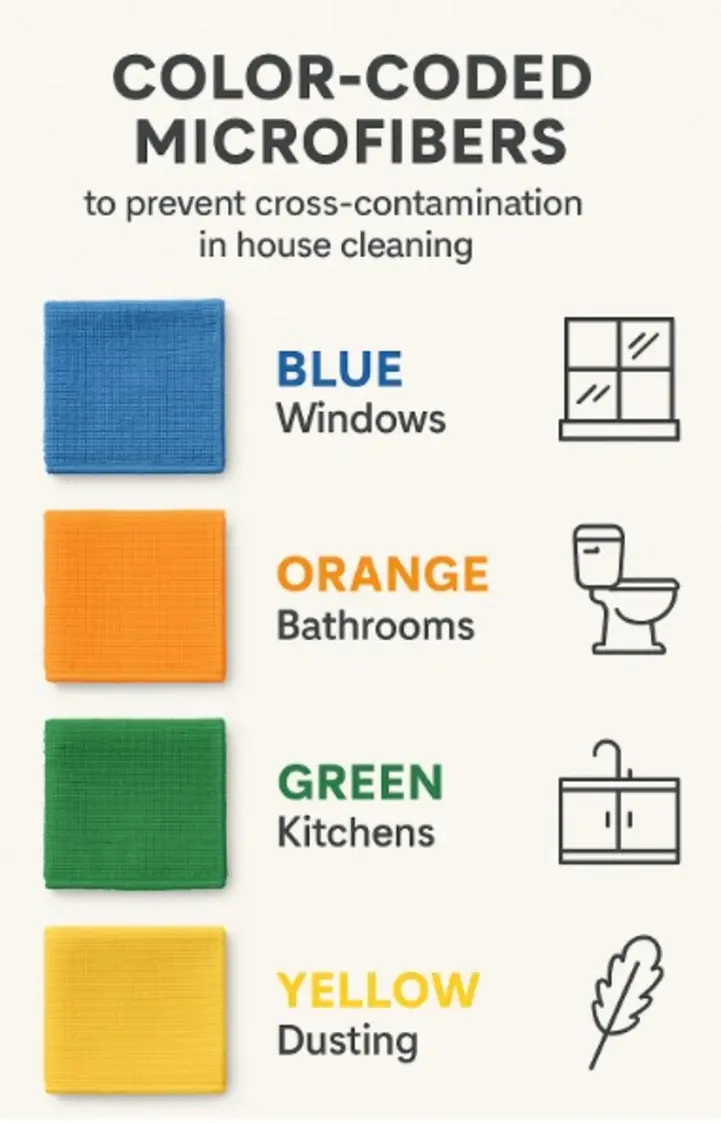
Source: healthyhomeshousecleaning
Check textile recycling options before using a collection bin
Textile recycling is preferable to trash only when the collection program specifically accepts your material and condition. Do not place old microfiber cloths in a clothing donation bin unless the operator says that cleaning rags, synthetic textiles, or non-wearable household textiles are accepted.
When contacting or reviewing a program, ask these direct questions:
- Do you accept microfiber cleaning cloths, not just clothing?
- Do you accept polyester-polyamide or polyester-nylon blends?
- Can the cloths be stained, frayed, or non-wearable?
- Must they be washed and dry before drop-off?
- Are cloths with paint, oil, cleaning chemicals, or automotive residue excluded?
- Will the material be reused, converted into wiping material, mechanically processed, or discarded if it cannot be sorted?
This matters because “textile recycling” can describe several different outcomes. Some programs sort usable goods for reuse. Others process non-wearable textiles into lower-value products or industrial wiping materials. There are also specialized collection systems designed for microfiber cloths and mops. For example, one Denmark-based program described by ABENA collects used microfiber items and processes them into industrial rolls for wiping, suction, and covering applications. That shows that recovery systems can exist, but it does not mean a similar service is available in every country or community.
Bag only clean, dry cloths if the recycler requests that preparation. Wet or moldy textiles can create handling problems, and cloths carrying heavy residues may be rejected. Never try to solve uncertainty by putting microfiber rags in curbside recycling meant for bottles, cans, paper, or rigid plastic packaging. Those systems generally are not designed for loose textiles.
Know when regular disposal is the responsible choice
Put the cloth in the trash when it has no safe reuse left and no verified textile-recycling outlet accepts it. This can include cloths that are:
- Falling apart or shedding extensively.
- Saturated with substances that make them unsuitable for ordinary textile handling.
- Moldy, badly degraded, or impossible to clean adequately.
- Mixed with non-textile parts or residues that a local recycler will not accept.
- Rejected by every accessible reuse or textile collection program.
Microfiber is a plastic-based textile and does not readily biodegrade. That is a reason to use each cloth for as long as it remains appropriate, but it does not make indefinite reuse safe or effective. Keeping a damaged rag in service can spread residue, scratch delicate surfaces, or create hygiene problems. Once no responsible recovery route is available, throwing it away is more honest than contaminating a donation stream or placing it in the wrong recycling bin.
Make the next set of cloths last longer
The best microfiber cloth disposal strategy starts before the cloth is worn out. Launder cloths after use so dirt and residues do not remain embedded in the fibers. Keep them separated by task, especially between food areas, bathrooms, vehicle work, and general dusting. Avoid using a cloth intended for delicate surfaces on abrasive or greasy jobs, then expecting it to return to finish-sensitive cleaning.
Use the cloth efficiently as well. Folding it into sections lets you rotate to a clean area rather than immediately reaching for another cloth. When a cloth finally loses its best performance, assign it to one lower-risk job instead of continuing to use it everywhere.
The practical order is simple: keep a functioning cloth in service, downgrade it when it no longer suits delicate work, use a verified textile recycling option when one accepts it, and dispose of it only when those routes are no longer appropriate. That approach avoids unsupported recycling claims while getting the longest reasonable life from the microfiber cloths you already own.
References
- How Can You Recycle Microfiber Towels?. shop.arpe.es. https://shop.arpe.es/blogs/arpe-stories/how-to-recycle-microfiber-towels
- Microfiber Cloths: Green Cleaning or Plastic Pollution? | Wellness Mama. wellnessmama.com. https://wellnessmama.com/natural-home/microfiber-green-cleaning
- New system to recycling microfibers. abena.com. https://www.abena.com/knowledge-center/sustainability/new-system-to-recycling-microfibers
- Microfiber Cleaning Cloths — Color-Coded, One Per Job. youtube.com. https://www.youtube.com/watch?v=eqLDEYtdpQ4&vl=en
- How do microfiber cloths work? | The science of cleaning. explainthatstuff.com. https://www.explainthatstuff.com/microfibercloths.html
- Getting the most out of microfiber cloths. hillyard.com. https://www.hillyard.com/blog-microfiber-cloths-for-cleaning
- What Is Microfiber’s Environmental Impact? | Blueland. blueland.com. https://www.blueland.com/articles/is-microfiber-bad-for-the-environment
- Microfiber cloths : r/ZeroWaste. reddit.com. https://www.reddit.com/r/ZeroWaste/comments/1u98a5n/microfiber_cloths