Why Is a Pigment Binder Not the Same as Dyeing?
Table of Contents
A pigment binder is not the same as dyeing because it attaches color to the surface of a textile, whereas dyeing uses a colorant that is dissolved or otherwise carried into the fiber and then fixed there. Both methods can make fabric look colored, and both can be useful in textile work. But their mechanisms, materials, hand feel, and likely wear behavior are different.
This distinction matters especially in natural-color practice. A soy milk binder can be a valid traditional material for holding color on cloth, but it does not automatically turn a pigment application into dyeing. Likewise, natural dye mordants are not simply interchangeable with binders: mordants help certain dyes fix to fibers, while binders form the material that holds pigment particles onto a textile surface.
The short version: dyes interact with fibers; pigments need something to hold them
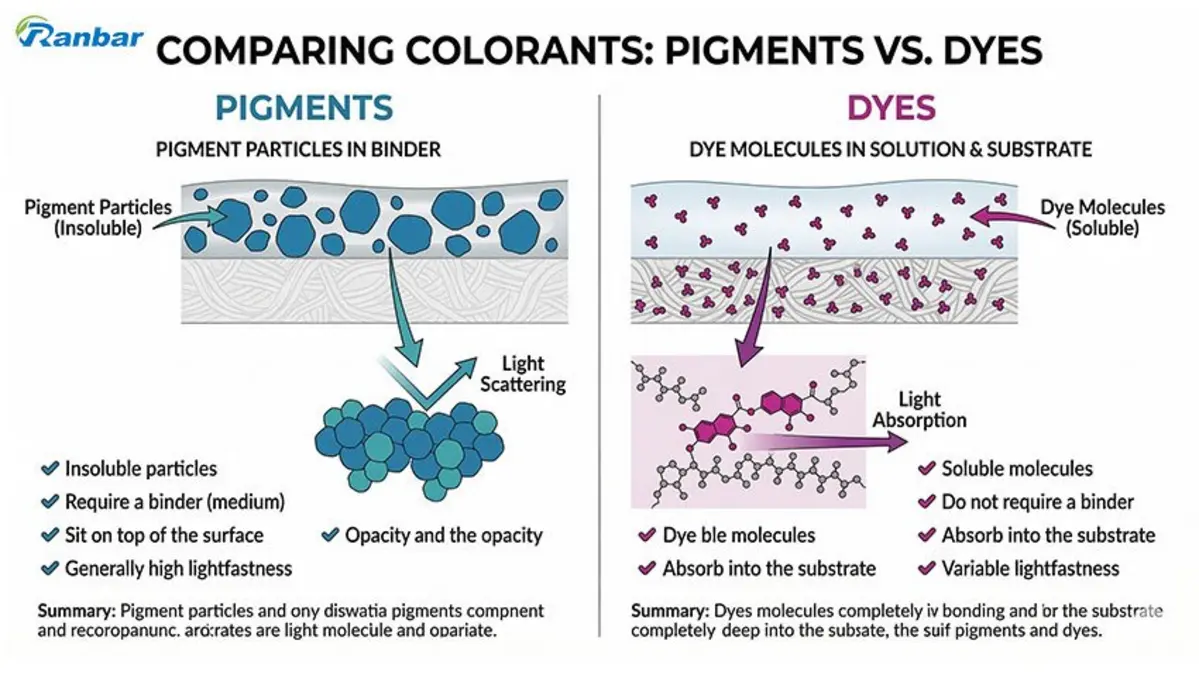
A dye is generally a colorant that can be dissolved in its application medium. During dyeing, the colorant moves into or around the fiber structure and is fixed through an appropriate combination of fiber type, heat, time, pH, salts, mordants, or other process conditions. The exact chemistry varies substantially by dye class and fiber.
A pigment is different. Pigments are insoluble colored particles. They retain their particulate form rather than dissolving as a dye does. Since a pigment does not have its own effective bonding mechanism for many textile fibers, it is normally applied with a binder. The binder creates a film or resin matrix that anchors the pigment to the cloth.
Cotton Incorporated’s technical bulletin describes pigment coloration as a binder system: pigment is dispersed in water, combined with a binder, dried, and then cured with heat so the binder system can form the colored matrix on the fabric. It also notes that calling pigment application on cotton “pigment dyeing” can be misleading because the fiber is functioning as the base to which the pigment-colored resin matrix adheres.
What actually happens in a dye bath
In dyeing, the goal is not merely to place color on a textile. The goal is to create durable dye-fiber bonding or fixation appropriate to the fiber and dye being used.
For example, a natural colorant may be extracted into water, and a textile is then exposed to that dye liquor under conditions suited to its fiber. Some natural dyes can color fibers with little or no mordant, while others need a mordant for better fixation, altered shade, or improved washfastness. Protein fibers such as wool and silk and cellulose fibers such as cotton and linen do not behave identically, so a process that works well on wool may not transfer directly to cotton.
A mordant is not usually a glue. In natural dyeing, a mordant is a substance used to help form or strengthen an association between certain dye molecules and the fiber. It can affect both color and durability. That role is fundamentally different from a pigment binder, which physically holds pigment particles in place.
This is why “no mordant” does not always mean “not dyeing,” and “contains soy milk” does not always mean “dyeing.” The decisive question is how the colorant is being retained: through dye-fiber fixation, or through a separate binding film.
What happens in a pigment binder system
With textile pigments, the pigment particles are mixed or dispersed into a vehicle that includes a binder. Depending on the application, the mixture may also include water, thickener, softener, crosslinking components, or other formulation aids. It can be printed, painted, padded onto cloth, or used in a garment-coloration process.
After application, the water dries away. Heat curing is commonly used in industrial systems to develop the binder film and improve adhesion. The colored particles remain at or near the textile surface, encapsulated or anchored by that binder layer.
Source: ranbarr
This surface mechanism creates important tradeoffs:
- Versatility: Pigments can be used across many fiber types because the binder, rather than a specific dye-fiber affinity, does much of the work.
- Design control: Pigment systems are particularly useful for printing, painting, stenciling, and localized marks because color can stay where it is placed.
- Hand feel: Too much binder, an unsuitable binder, or a heavy pigment layer can make fabric feel stiffer.
- Wear pattern: Repeated abrasion, flexing, laundering, and surface rubbing can affect a binder-held color layer differently from color fixed within a fiber.
- Curing dependence: A pigment result may depend heavily on using the binder as directed and curing it correctly.
These are general tendencies, not guarantees. A well-designed pigment print can be durable, and a poorly executed dye process can fade or bleed. The point is that the failure modes are different because the attachment mechanism is different.
Where soy milk fits
Soy milk is often discussed in natural textile-color communities because its proteins can function as a binder in some surface-color applications. It is especially associated with Japanese textile practices involving brushed, painted, or otherwise applied color.
In the supplied Reddit discussion, a user states that soy milk has been used as a binder for pigments on Japanese textiles for centuries, while emphasizing that pigment binding should not be confused with dyeing. That comment is a useful prompt for the distinction, although the brief discussion excerpt is not, by itself, a complete technical history.
A soy milk binder may be used with a colorant placed onto fabric, allowing protein-containing material to help hold that color at the surface. The visual result can be beautiful, and it may be exactly the right process for painterly marks or controlled placement. But if the color is being retained principally by the soy-based binder rather than by a dye’s fixation to the textile fiber, it is more accurate to describe the process as pigment or surface-color application rather than dyeing.
That does not make it inferior. It simply gives it the right name and helps the maker choose suitable expectations for curing, laundering, rubbing, and future care.
Why the terminology becomes confusing
The phrase “pigment dyeing” is widely used in apparel and textile production. It usually describes a process that gives garments or fabrics a washed, worn, muted, or vintage-looking color effect. Yet the word “dyeing” in that label can obscure the fact that pigments need a binder system to remain on the textile.
The technical distinction is clearer when you ask two questions:
- Is the colorant soluble or able to penetrate and fix within the fiber under the process conditions? If so, it is functioning as a dye.
- Are insoluble colored particles being held to the fabric by a polymer, protein, or other binding material? If so, it is functioning as a pigment-binder system.
Some projects may include elements of both. For instance, a fabric could be conventionally dyed first and then printed with pigment on top. In that case, the base color and the printed design are created by different mechanisms.
How beginners can choose the right approach
Choose dyeing when you want color to become part of the fiber through an appropriate dye process. This is generally the better starting point for immersion dyeing, all-over coloration, and learning how natural dye mordants influence particular dyes and fibers.
Choose a pigment binder approach when you want to apply color selectively to the textile surface: painted motifs, prints, brushwork, stencils, or decorative layers. A soy milk binder may be relevant when exploring traditional or low-synthetic-material surface-color methods, but it should be treated as a binder system with its own preparation and care needs.
Do not choose a method solely because it is described as “natural.” Natural origin does not tell you whether something is a dye, pigment, mordant, or binder, nor does it establish durability or safety. Natural dye materials, mordants, and pigment ingredients can all require careful handling. Follow supplier instructions, avoid breathing powders, use dedicated tools where appropriate, and do not use dye or mordant equipment for food preparation.
The most useful habit is to describe your process plainly: “I dyed this fabric with a natural dye,” “I painted it with pigment and soy binder,” or “I printed pigment onto a dyed ground.” Accurate terms make it easier to repeat a process, troubleshoot poor fastness, and understand what the cloth needs in use.
References
- Pigment Dyeing | PPTX. slideshare.net. https://www.slideshare.net/slideshow/pigment-dyeing/37598557
- An innovative process combines garment dyeing and pigment .... facebook.com. https://www.facebook.com/cpcompany/posts/an-innovative-process-combines-garment-dyeing-and-pigment-overdyeing-to-create-d/1544790701020395
- [PDF] BINDERS FOR TEXTILE APPLICATIONS - TECHNICAL BULLETIN. cottoninc.com. https://www.cottoninc.com/wp-content/uploads/2017/12/ISP-1008-Binders-for-Textile-Applications.pdf
- Dyes vs. Pigments: Key Differences | PDF | Dye | Pigment. scribd.com. https://www.scribd.com/document/329484070/Difference-Between-Dyes-and-Pigments
- “You don’t need cHeMiCaL mordants for natural dyeing! .... reddit.com. https://www.reddit.com/r/BitchEatingCrafters/comments/1tpszpr/you_dont_need_chemical_mordants_for_natural
- Differences Between Dyes and Pigments | Type of Dyes Textile. chemworldintl.com. https://www.chemworldintl.com/fundamentals-dyes-pigments.html
- Cotton Fabric Dyeing Methods: Reactive Vs Vat Vs Pigment. fabric-supplier.com. https://fabric-supplier.com/reactive-vs-vat-vs-pigment
- The ABCs of Art Materials —Pigments and Dyes—. pigment.tokyo. https://pigment.tokyo/en/blogs/article/abc-pigments-dyes