Why Is Plastic-Free Stretch Fabric Still So Hard to Make?
Table of Contents
Plastic-free stretch fabric is hard to make because the garments that need the most stretch—leggings, sports bras, cycling shorts, and fitted performance tops—also need dependable recovery. They must extend repeatedly, return close to their original dimensions, resist sagging, and maintain fit through sweat, movement, and laundering. Conventional elastane makes that combination comparatively easy at a very low blend percentage.
Natural fibers and plastic-free constructions can provide comfort, movement, and moderate stretch. But they do not automatically reproduce the high extension and close body-hugging recovery expected from modern activewear. That is why a fabric can be genuinely plastic-free yet still be a poor substitute for a compression legging or a high-support sports bra.
Stretch and recovery are not the same thing
“Stretch” is a fabric’s ability to extend under force. “Recovery” is its ability to spring back after that force is removed. Both matter, but recovery is usually the more difficult requirement.
A loosely knitted cotton jersey can stretch because its loops open and rearrange. It may feel comfortable for a T-shirt, lounge set, or easy-fit top. Yet after repeated wear, some of that temporary extension can remain. The garment can become wider, longer, or baggier rather than returning to its intended fit.
Elastane, also called spandex in the United States, is widely used because it behaves as a highly elastic fiber. A relatively small amount can give a fabric substantial extension and strong recovery. It also helps designers make garments that stay close to the body without requiring a very loose fit or rigid construction.
This is the central challenge for plastic-free activewear: replacing elastane is not simply about finding a soft natural fiber. It means replacing a specific mechanical function.
Why synthetic elastic fibers became standard
Most mainstream stretch performance fabrics combine a base fiber, often polyester or nylon, with elastane. The base fiber can contribute strength, abrasion resistance, moisture management, or a smooth hand. Elastane supplies much of the shape retention and elastic rebound.
That formula is especially useful in garments that are expected to do several jobs at once:
- fit snugly without restricting movement;
- withstand repeated bending, squatting, and pulling;
- retain their silhouette after many wears and washes;
- remain opaque when stretched; and
- provide varying levels of support or compression.
A high-stretch garment also has many components beyond its main fabric. Waistbands, elastic bindings, sewing thread, logos, heat transfers, labels, foam, and closures may contain synthetic polymers. A product described as “plastic-free fabric” is therefore not necessarily a fully plastic-free garment.
A discussion about fully plastic-free activewear on Reddit specifically raised this practical difficulty around pieces such as leggings, sports bras, and cycling shorts. That consumer question reflects a real product-development issue: removing plastic from every stretch-dependent component is considerably harder than replacing one fiber in the main fabric.
Mechanical stretch is useful, but it has limits
The most established route to plastic-free stretch fabric is mechanical stretch. Instead of relying on an elastic synthetic filament, the fabric is engineered so its yarns or structure can move, compress, or recoil.
Knit construction
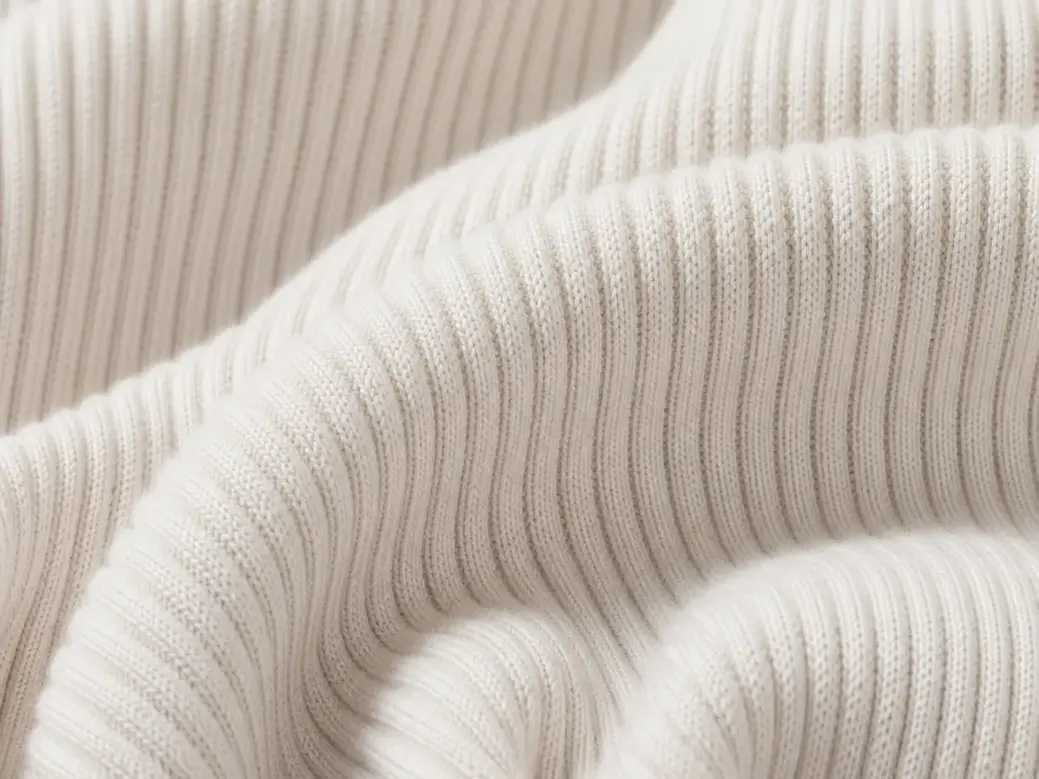
Knits naturally have more give than most woven fabrics because the yarn is formed into interconnected loops. Rib knits, interlocks, and other knit structures can be designed for softness and movement. A well-designed natural-fiber knit may work well for relaxed activewear, yoga layers, base layers, underwear, socks, or tops where ease of movement matters more than compression.
However, a knit’s flexibility does not guarantee elastane-like recovery. The loops may gradually relax, especially in a body-hugging garment subjected to repeated strain. Fabric weight, stitch density, yarn twist, finishing, and garment pattern all influence the result.
Woven mechanical stretch
Woven fabrics can gain flexibility through yarn selection, weave design, twist, and finishing. Crepe yarns and crepe weaves can create elasticity through their structure. Some cotton constructions use controlled weaving and finishing to introduce permanent flexibility without synthetic elastic fibers.
For example, CottonWorks describes a cotton mechanical-stretch approach in which yarn spacing and controlled shrinkage during finishing create a spring-like configuration in the fabric. This can provide useful comfort and recovery in woven cotton.
That kind of stretch is particularly relevant to denim, trousers, overshirts, and workwear. It is usually not a direct replacement for the very high, multidirectional stretch expected from fitted sportswear.
Wool’s natural elasticity
Wool has inherent resilience because its fibers have a natural crimp. This can give wool fabrics bounce and recovery that many plant fibers do not provide on their own. Wool-based knits may be a practical option for next-to-skin layers, socks, travel clothing, and lower-impact activewear.
Still, wool is not a universal answer. Its performance depends on fiber quality, yarn construction, fabric weight, care requirements, and the intended garment. It also does not automatically create the smooth, firm, high-compression feel associated with synthetic leggings.
Source: runtangtex
Natural rubber is a promising elastic-fiber route
Natural rubber is one of the most significant non-petroleum options for supplying true elastic behavior. It can be used as an elastic component in yarns and fabrics, offering a closer functional substitute for elastane than ordinary cotton or cellulosic fibers can.
Natural-rubber stretch systems are already being explored in denim and other apparel. CottonWorks highlights stretch denim using natural rubber, while Yulex presents YULASTIC as a natural-rubber alternative to elastane.
The important qualification is that “natural rubber” does not make every finished textile automatically simple, biodegradable, or plastic-free. A garment’s full material list still matters. Rubber yarn may be combined with other fibers, dyes, finishes, sewing threads, and trims that change the product’s overall makeup and end-of-life options.
Availability is another constraint. Elastane is deeply established in global textile supply chains; it is available in many yarn counts and fabric constructions and is familiar to mills, pattern makers, and brands. New natural-rubber systems require compatible manufacturing, reliable sourcing, and long-term performance validation for each application.
Why plant-based fibers alone do not solve fitted activewear
Cellulosic fibers such as cotton and lyocell can offer important comfort benefits. Lyocell is often valued for softness and breathability, while cotton is familiar, durable, and versatile. But neither fiber is inherently a high-recovery elastic fiber.
A brand can improve movement through knitting, pattern shaping, gussets, panels, and a less restrictive silhouette. Those decisions may reduce the need for elastane, but they can also change what the garment is. A loose running tee and a high-support sports bra are not solving the same design problem.
This is why claims about “elastane-free activewear” need close reading. An elastane-free garment may be a valuable lower-plastic choice, but it may rely on polyester-based mechanical stretch, another synthetic elastic polymer, or simply a more relaxed fit. None of those options is necessarily plastic-free.
Lower-plastic is not the same as plastic-free
For some uses, reducing rather than eliminating synthetic elastic fibers may be the most realistic current compromise. Recycled elastane, bio-based elastane, and biodegradable elastane are often presented as improved alternatives to conventional elastane. They may reduce reliance on virgin fossil inputs or offer different end-of-life characteristics under specified conditions.
But they remain synthetic elastic fibers. They should not be marketed as plastic-free.
Première Vision’s overview of elastane alternatives distinguishes mechanical stretch, recycled elastane, bio-based elastane, and other elastic materials. These approaches address different sustainability priorities. A mono-material polyester stretch fabric, for example, may be easier to route into a polyester recycling stream than a polyester-elastane blend, but it is still a synthetic textile.
The practical lesson is to separate three claims that are often blended together:
- Plastic-free: no plastic-based materials in the claimed item or garment.
- Lower-plastic: reduced synthetic content, but not necessarily zero.
- More circular or lower-impact synthetic: still plastic-based, but designed with recycled content, alternative feedstocks, or recycling compatibility in mind.
What plastic-free stretch fabric can realistically do today
Plastic-free stretch fabric is most convincing where the performance requirement is moderate rather than extreme. Good potential uses include comfort-stretch denim, relaxed trousers, woven shirts with added ease, socks, underwear, soft bras with modest support, knit tops, and low-impact movement clothing.
It is much more difficult in garments that depend on high stretch and firm recovery: compression tights, sculpting shorts, high-support sports bras, swimwear, and technical cycling apparel. These products are designed around tight fit, repeated extension, and stable compression. Mechanical stretch can help, but it may require compromises in fit, support, lifespan, fabric bulk, or freedom of design.
For shoppers, the most useful question is not simply, “Is this plastic-free?” Ask what kind of stretch the garment needs and whether its construction matches that purpose. Look for clear fiber content, information about elastic waistbands and trims, and an honest description of expected use.
For product developers, the best opportunity is to design backward from the real performance requirement. If a garment only needs comfort and mobility, a natural knit or mechanically stretched woven fabric may be enough. If it must deliver sustained compression and close recovery, natural rubber or a carefully justified lower-plastic elastic system may be more realistic than claiming an all-natural substitute can behave exactly like elastane.
Plastic-free stretch fabric is difficult not because designers lack interest in it, but because stretch is a system-level performance feature. Fiber, yarn, knit or weave structure, finishing, pattern engineering, seams, and trims all have to work together. Progress is real, but the most credible products are those that match their material claims to the level of performance they can actually deliver.
References
- Plastic-Free Performance Fabrics: Sustainable, Stretch, Windproof, Weatherproof | HerMin Textile. hermin.com. https://www.hermin.com/blog/featuring-4/plastic-free-performance-fabric-stretch-windproof-weatherproof-and-more-11
- Plastic-Free Activewear: Why Elastane Is Still Used (And Safer Options – Tripulse. tripulse.co. https://tripulse.co/blogs/news/plastic-free-activewear-elastane-guide
- Alternative stretch fabrics: what sustainable options to supplant elastane?. premierevision.com. https://www.premierevision.com/en/articles/61b987d8-76fa-ef11-90cb-00224888722c/alternative-stretch-fabrics-what-sustainable-options-to-supplant-elastane-
- The Rise of Plastic-Free Stretch Denim | CottonWorks™. cottonworks.com. https://cottonworks.com/news/plastic-free-stretch-denim
- Introducing YULASTIC® — A new, natural, and sustainable alternative to elastane | YULEX®. yulex.com. https://www.yulex.com/post/introducing-yulastic-a-new-natural-and-sustainable-alternative-to-elastane
- How Sustainable is Spandex? – Sportek International Inc.. sportek.com. https://sportek.com/blogs/news/how-sustainable-is-spandexhow-sustainable-is-spandex
- Why Stretch Recovery Matters in Sportswear Fabric. linkedin.com. https://www.linkedin.com/posts/functionalfabricsmanufacturer_stretchrecovery-sportswearfabric-functionalfabric-activity-7512151882866270209-HsSh
- Stretch Responsibly: Your Guide to Sustainable Elastane — rewildist. rewildist.com. https://www.rewildist.com/field-notes/stretch-responsibly-your-guide-to-sustainable-elastane