How Can You Prevent Clothes From Shrinking in the Wash?

Table of Contents
To prevent clothes shrinking, use the garment’s care label as the starting point, wash vulnerable items in cold or cool water on a gentle cycle, and avoid high-heat tumble drying. For many everyday garments, the dryer is the highest-risk stage because it combines heat with prolonged tumbling. Wool, viscose, cotton knits, and loosely constructed garments need more caution than stable synthetic fabrics.
Laundry shrinkage is not caused by one universal rule. Heat, moisture, mechanical agitation, fiber type, and fabric construction can all contribute. A cotton T-shirt, a wool sweater, and a polyester athletic top may all react differently to the same wash-and-dry routine.
Start with the care label, not the fiber name alone
The care label provides the manufacturer’s intended wash temperature, cycle, drying method, and ironing limits. That advice matters because the label reflects more than fiber content: it can account for the garment’s knit or weave, lining, trims, dyeing, finishing, and construction.
A 100% cotton garment may be machine washable, but it may still be labeled for low tumble drying or line drying. A wool garment may be marked hand wash, wool cycle, or dry clean only. A blend can behave differently from either fiber in isolation, especially if it includes elastane, a delicate knit structure, or heat-sensitive finishes.
If the label is missing, treat an unfamiliar garment cautiously: wash it cool, use a gentle cycle, and air dry it until you understand how it responds.
Why clothes become smaller after laundering
Many fabrics are held under tension at different stages of spinning, knitting, weaving, dyeing, and finishing. During laundering, moisture can make fibers and yarns more mobile. Heat and movement can then allow the structure to relax into a smaller, less tensioned state. This is often called relaxation shrinkage.
Cellulosic fibers such as cotton, linen, and viscose absorb water readily. Their fibers can swell, and their yarns or fabric loops can move as the garment is washed and dried. Knitted fabrics may be especially prone to dimensional change because their looped structure has more room to contract than a firm woven fabric.
Wool has an additional risk: felting. Wool fibers have overlapping surface scales. Under moisture, agitation, and heat, those scales can interlock, making the fabric denser, thicker, and substantially smaller. This is not simply ordinary relaxation shrinkage, and it is generally difficult to reverse once the fibers have felted.
Synthetic fibers such as polyester and nylon are usually more dimensionally stable under ordinary laundry conditions, often because they have been heat-set during production. That does not mean they are invulnerable. Excessive dryer or iron heat can distort thermoplastic fibers, affect stretch components, or permanently change the garment’s appearance and fit.
Reduce wash temperature, but do not ignore agitation
Cold or cool water is a sensible default for clothes you want to preserve, particularly cotton, rayon or viscose, wool, and blended knits. Lower wash temperature reduces the energy available for fibers to relax and contract. It can also be helpful for color care.
However, cold water does not eliminate every form of shrinkage. Water can still penetrate absorbent fibers, and a rough wash cycle can still create mechanical stress. This is particularly important for wool and delicate knits.
Choose the gentlest effective cycle for garments at risk of shrinking:
- Use delicate, hand-wash, or wool settings for wool, cashmere, fine knits, and garments labeled for gentle care.
- Use a normal or gentle cool cycle for cotton tees, sweatshirts, linen, and viscose when their labels permit machine washing.
- Avoid long, aggressive cycles when they are not needed.
- Do not overload the washer. Overcrowding can increase rubbing and twisting while also reducing cleaning performance.
- Use a lower spin option when available for delicate or highly shrink-prone pieces.
In a Reddit discussion about overlooked causes of shrinking, one laundry user described tumble drying as the biggest cause, followed by excessively hot washing. That is a useful troubleshooting lead rather than universal proof: the actual outcome still depends on the garment, label, fiber blend, cycle, and dryer settings.
Treat tumble drying as the key decision point
When a garment has repeatedly become smaller despite being washed in cool water, look closely at the drying stage. A tumble dryer combines heat and continuous mechanical action. The garment is repeatedly lifted, dropped, compressed, and exposed to moving hot air. That combination can advance relaxation shrinkage in cotton and viscose, while creating a serious felting risk for wool.
The most dependable way to prevent clothes shrinking is to air dry sensitive items. Hang sturdy woven garments on a hanger or line when appropriate. Dry sweaters, delicate knits, and garments that may stretch under their own wet weight flat on a clean drying rack or towel.
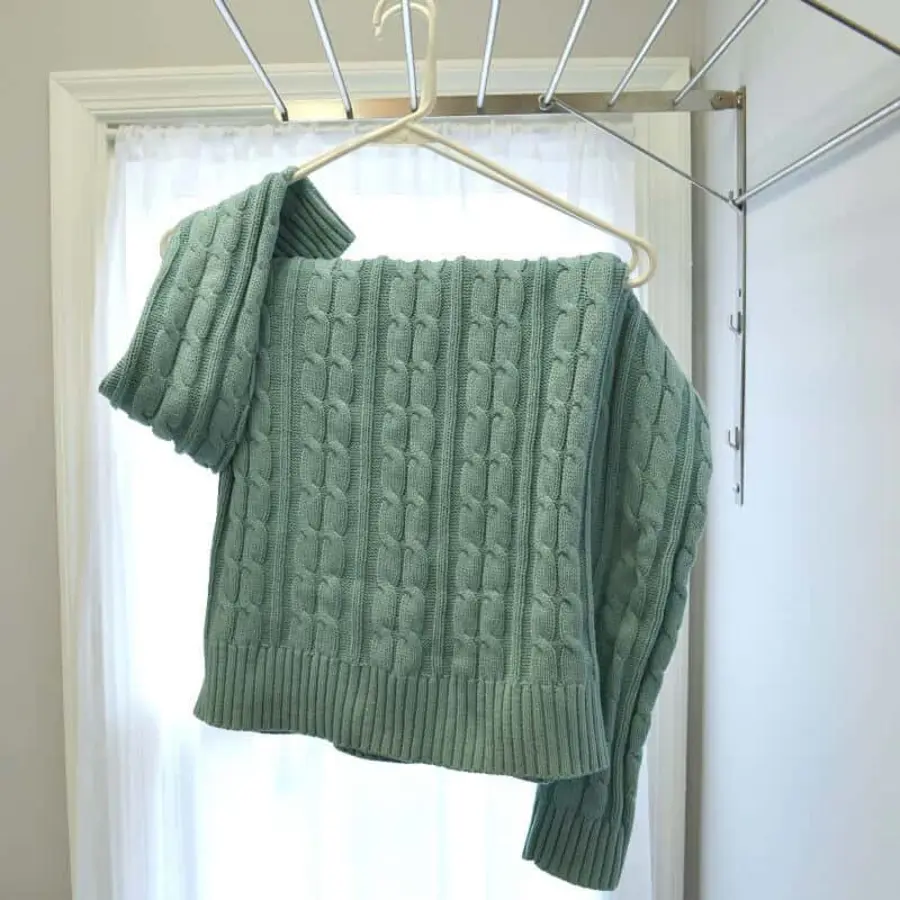
Source: organized31
If you use a dryer, reduce risk by using these habits:
- Select low heat, air dry, or the label-approved setting.
- Remove garments while they are still slightly damp rather than drying them until very hot and fully dry.
- Separate heavy items such as towels or jeans from lighter shirts and knits, since mixed loads can prolong drying time.
- Clean the lint filter so air can circulate efficiently and the dryer does not need to run longer than necessary.
- Avoid putting wool, cashmere, and other no-tumble items in the dryer, even briefly.
Pre-shrunk cotton can reduce the amount of initial dimensional change, but it is not a promise that a garment will never shrink. Repeated high-heat drying can still alter the fit of cotton clothing over time.
Match the method to the fabric
Cotton and linen
Cotton and linen can shrink as their fibers and yarns relax after exposure to moisture and heat. Cotton jersey T-shirts, sweatshirts, and other knits often need more care than a tightly woven cotton shirt because knit loops can retract more easily.
Wash cool or warm only when the label allows it, and prefer air drying or low dryer heat. If a cotton item is close-fitting or you want to preserve its original length, do not rely on a hot dryer.
Viscose, rayon, modal, and similar regenerated cellulosics
Viscose and rayon are absorbent and can be vulnerable to dimensional change and distortion when wet. Follow the label closely, use a gentle cycle where permitted, and avoid high dryer heat. Air drying is often the safer choice.
Wool, cashmere, alpaca, and other animal fibers
Wool requires the most conservative routine. Use cool water, a wool or hand-wash cycle if machine washing is allowed, and very low agitation. Do not wring the item. Reshape it gently and dry it flat unless the label gives different instructions.
The important distinction is that wool can felt through agitation as well as heat. A cold wash is helpful, but it is not enough if the cycle is too rough or the garment is tumble dried.
Polyester, nylon, acrylic, and performance blends
These fabrics are often more resistant to ordinary wash shrinkage, but high heat remains a concern. Use low or medium heat only if the label permits it, especially for stretch activewear. Elastane can lose recovery when repeatedly exposed to excessive heat, leaving the garment baggy or misshapen rather than simply smaller.
Blends
A blend generally follows the needs of its most sensitive component. Cotton-polyester may shrink less than all-cotton fabric, but the cotton portion can still relax. Cotton-elastane garments may hold their dimensions better than cotton alone but should not be exposed to unnecessary dryer heat.
Troubleshoot a garment that keeps shrinking
If only certain pieces are shrinking, compare their labels, fiber contents, and constructions rather than changing your entire laundry routine at once. Ask these questions:
- Did the garment go into a tumble dryer after washing?
- Was the dryer set hotter or run longer than the label allows?
- Is the item a knit, rib knit, loop-pile towel, or loose construction that can contract more readily?
- Does it contain wool, viscose, cotton, or another absorbent fiber?
- Was it washed on a high-agitation cycle or with heavy items?
- Has the garment shrunk mainly in length, width, or both?
For a valuable or uncertain garment, measure key dimensions before the first wash: chest width, body length, sleeve length, waistband, or inseam. This is especially useful for sewing fabric and handmade garments. A Reddit sewing discussion noted that some materials may continue changing after more than one wash and suggested measuring a swatch over repeated washes. That is an individual community suggestion, but measuring before and after laundering is a practical way to identify dimensional change in your own fabric.
The simplest prevention routine is therefore fabric-aware: follow the care label, choose cool water and low agitation for vulnerable garments, and reserve high-heat tumble drying for items specifically designed to tolerate it. When in doubt, gentle washing and air drying provide the widest margin of safety.
References
- Shrinkage in the Washer and Dryer: Causes and Solutions | Speed Queen. laveries-speed-queen.fr. https://laveries-speed-queen.fr/en/blog/prevent-shrinking-guide
- Why Do Clothes Shrink? Causes & How to Prevent It | Dutch Label Shop. dutchlabelshop.com. https://www.dutchlabelshop.com/en_us/blog/why-do-clothes-shrink
- How to Prevent Clothes from Shrinking | Parkway Custom Dry Cleaning. parkwaydrycleaning.com. https://www.parkwaydrycleaning.com/how-to-prevent-clothes-from-shrinking-and-what-to-do-when-its-already-too-late
- What Actually Shrinks Clothes: Heat or Agitation?. elementformen.com. https://www.elementformen.com/blogs/element-blog/what-shrinks-clothes
- Fabric Shrinkage Explained: Causes, ISO/AATCC Testing and Prevention Techniques - Textile Tester. darongtester.com. https://darongtester.com/fabric-shrinkage-explained
- How to Prevent Clothes From Shrinking in the Wash | The Laundry Spot. laundryspot.com. https://laundryspot.com/blog/how-to-prevent-clothes-from-shrinking
- Why Do Clothes Shrink? (And How to Prevent It). pilgrimdrycleaners.com. https://www.pilgrimdrycleaners.com/why-clothes-shrink
- Why do some clothes shrink in the wash? A textile scientist explains how to ‘unshrink’ them. theconversation.com. https://theconversation.com/why-do-some-clothes-shrink-in-the-wash-a-textile-scientist-explains-how-to-unshrink-them-259388