How Should Shoppers Evaluate Recycled Polyester Microfiber-Shedding Claims?
Table of Contents
Recycled polyester is not automatically a higher- or lower-shedding choice than virgin polyester. A shopper should treat any recycled polyester microfiber shedding claim as a claim about a specific fabric, garment, washing test, and comparison—not as a universal fact about all rPET fabric.
Some controlled studies and recent garment testing have reported higher microfiber release from recycled polyester than comparable virgin polyester. Other research has found no statistically significant difference across broader fabric samples. That disagreement does not mean the issue is unknowable. It means that fiber source is only one variable, while yarn quality, fabric construction, finishing, garment condition, and laundering conditions can substantially change the result.
Start by separating the claim from the garment
A brand may say that a product uses recycled polyester, has recycled content certified through its supply chain, or reduces dependence on virgin fossil-based material. Those may be relevant sustainability attributes, but they do not by themselves establish low synthetic textile shedding.
Likewise, a claim that “recycled polyester sheds more” should prompt a few questions:
- Compared with what: a matching virgin-polyester version, a different fabric, or a market-wide average?
- Measured how: by particle count, released mass, fiber length, or another metric?
- After which wash: one new-garment wash, repeated laundering, or a test designed to simulate use?
- What was actually compared: similar knit structures and garment types, or unlike products with different weights, finishes, and surface textures?
A useful claim identifies the material composition and gives enough test context to tell whether the comparison is meaningful. A broad statement about all recycled polyester does not.
Why fiber source alone cannot predict shedding
Mechanical recycling can affect polyester polymer properties and fiber performance, particularly if recycled material is processed through multiple stages or made into staple fibers. Some studies have linked recycled polyester with shorter fibers or reduced strength, conditions that could make fragmentation more likely in certain constructions.
For example, early controlled research cited in a later comparative study found that rPET knitted fabrics released substantially more and shorter microfibers than virgin-polyester equivalents under the tested laundering conditions. The later research also notes that other studies have found no clear difference between primary and recycled polyester. This is an important limitation: the available evidence supports concern and scrutiny, not a blanket rule for every recycled garment.
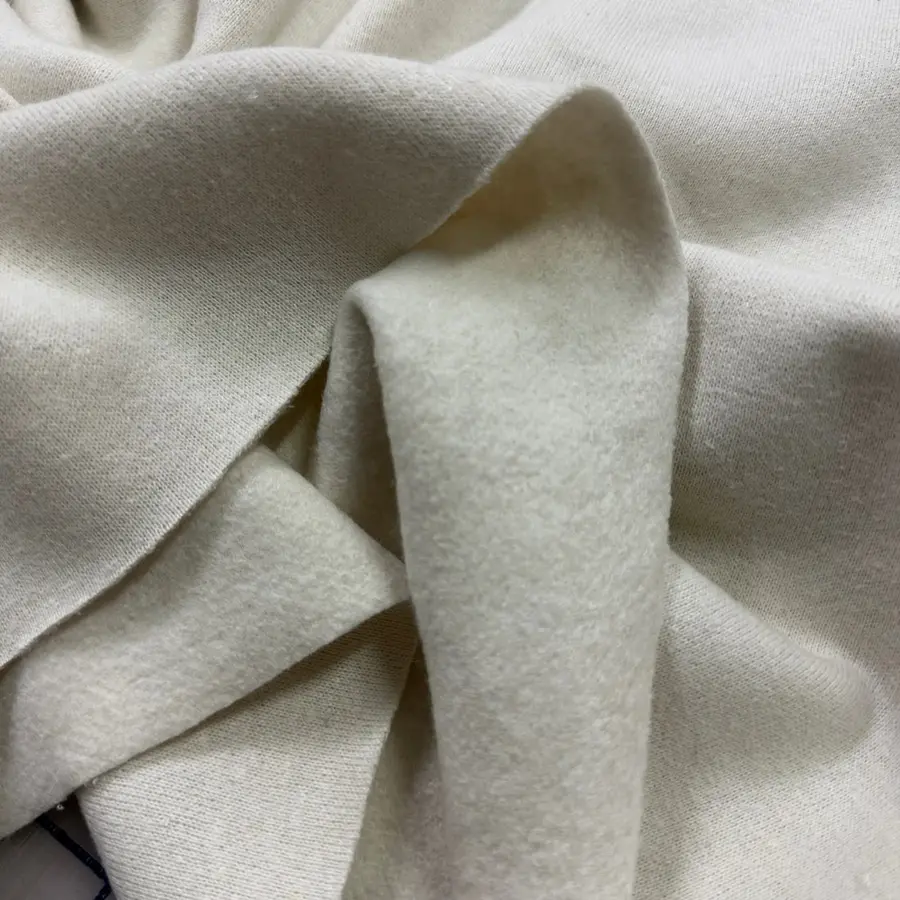
Construction often changes the practical result. A densely woven, smooth polyester shell can behave very differently from a brushed fleece, loose knit, fuzzy sweatshirt, or mechanically distressed activewear fabric. Yarn twist, filament versus staple-fiber yarns, fiber length, fabric density, seam and edge abrasion, and chemical or mechanical finishing can all influence what loosens during laundering.
Source: naturesfabrics
When comparing products, do not assume that a recycled fleece and a virgin woven jacket are a valid material comparison. Their surfaces and structures may be the primary reason for different results.
Look for evidence that matches the product being sold
The strongest brand evidence is product-specific and transparent. A useful disclosure should explain whether testing was conducted on a finished garment or a fabric swatch, identify the washing conditions, and state the result in a clear unit.
Ask whether the brand can provide:
The exact product or material tested
A result from one polyester jersey should not be applied automatically to every item in a collection. Ideally, the tested material should match the product’s fiber blend, recycled-content percentage, knit or weave structure, weight, finish, and intended use.
A claim about 100% recycled polyester also does not answer how a recycled-polyester-and-elastane blend will perform. Blends, coatings, prints, brushed surfaces, and bonded layers can all make direct comparisons harder.
A fair comparison group
The most informative comparison holds as many variables constant as possible. That means comparing recycled and virgin polyester with similar construction, weight, finish, and garment category, then laundering them under the same conditions.
Be cautious with claims based on comparisons between a lightweight virgin-polyester shirt and a heavy recycled fleece, for example. The results may be real for those products, but they cannot isolate recycled content as the reason.
The testing protocol and reporting metric
Microfiber results can differ depending on the washing machine, water temperature, detergent, load composition, agitation, wash duration, and sample preparation. Results also vary when researchers count particles rather than measure released mass.
A number without a method is difficult to interpret. A credible disclosure does not need to overload shoppers with laboratory detail, but it should say what was tested, how it was washed, what was measured, and whether the figure reflects one wash or repeated washes.
Some public reports say their tests used standardized washing methods, but shoppers should still look beyond that phrase. Standardized conditions improve comparability; they do not make results from different garment types interchangeable or prove that one test represents every household laundry routine.
Treat dramatic headlines as a prompt to inspect the study
A 2025 report from Changing Markets, based on testing commissioned from a university research group, reported that sampled recycled-polyester garments released about 55% more fibers per gram on average than sampled virgin-polyester garments. The report also stated that the recycled-polyester particles were smaller on average. Those findings are relevant evidence that recycled content should not be marketed as a microfiber solution without testing.
However, the report examined a defined group of garments from selected major brands, not every recycled-polyester textile on the market. As coverage of the study noted, the sample size and product scope mean the results are an indication of likely pollution rates rather than a universal ranking for all rPET fabric. Brand responses also emphasized that recycled polyester does not consistently shed more or less than virgin polyester across every fabric.
This is the practical takeaway: a study may validly identify a risk pattern while still not predicting the performance of the specific garment in your cart.
A Reddit discussion about plastic microfiber shedding similarly circulated the statement that recycled PET shed significantly more than virgin polyester in a single 40°C wash under otherwise identical conditions. That linked discussion is a useful example of the type of claim shoppers encounter, but the excerpt alone is not enough to verify the underlying study design, fabric construction, or scope. It should be treated as a lead to investigate, not as proof that all recycled polyester performs the same way.
What shoppers can reasonably prefer
If microfiber pollution is a priority, favor product characteristics that make low shedding more plausible and claims easier to verify:
- Smooth, tightly constructed fabrics rather than highly brushed or fuzzy surfaces when they suit the intended use.
- Durable garments with clear fiber-content and care information.
- Brands that distinguish recycled-content claims from shedding claims instead of presenting one as proof of the other.
- Brands that disclose product testing or explain how they reduce fiber loss through material and construction choices.
- Garments you expect to wear often and keep in service, rather than low-cost items likely to be replaced quickly.
These are risk-reduction choices, not guarantees. A smooth recycled-polyester item may still shed, and a fuzzy virgin-polyester item may shed heavily. The goal is to avoid unsupported assumptions while choosing a garment designed for a longer useful life.
Use care practices as a secondary safeguard
Care cannot erase shedding built into a fabric, but laundering is one of the stages where fibers can be released. Follow the care label, avoid unnecessary washing, wash full but not overloaded loads, and avoid abrasive treatment when possible. Replacing a garment only because it is recycled polyester can also be a poor sustainability decision if the item is otherwise durable and wearable.
When a garment is already visibly pilling, thinning, or shedding surface fuzz, it may be approaching a stage where fiber loss deserves extra attention. Repairing seams, removing loose debris carefully, and extending the life of a sound garment can be more useful than treating recycled content as the only environmental criterion.
A better way to read sustainability marketing
The most reliable shopper response is not “recycled polyester is always worse” or “recycled polyester is automatically greener.” It is: recycled content addresses one part of a product’s material story, while microfiber pollution requires separate evidence.
Prefer brands that make narrow, testable statements. “This fabric was tested under specified laundering conditions” is more useful than “our recycled polyester reduces environmental impact.” If a brand cannot explain what it tested or what its claim means, consider its microfiber language unproven and judge the item on other visible factors: construction, durability, use frequency, repairability, and whether you genuinely need it.
References
- Recycled Polyester and Microfiber Shedding: The rPET Problem. e-a.earth. https://www.e-a.earth/insights/the-recycled-polyester-problem-nobody-wants-to-talk-about
- Recycled polyester sheds MORE microfibres than virgin .... facebook.com. https://www.facebook.com/ChangingMarkets/videos/-breaking-recycled-polyester-sheds-more-microfibres-than-virgin-polyester-when-w/1929076314622787
- Spinning Greenwash: How the fashion industry’s shift to recycled polyester is worsening microplastic pollution • Changing Markets. changingmarkets.org. https://changingmarkets.org/report/spinning-greenwash
- Recycled Polyester Worsens Microplastic Pollution, Study Finds | Changing Markets Foundation posted on the topic | LinkedIn. linkedin.com. https://www.linkedin.com/posts/changing-markets_breaking-recycled-polyester-sheds-more-activity-7404444807240237056-fMCX
- Comparative microfiber shedding from natural, virgin and recycled synthetic textiles under standardised laundering conditions - IOPscience. iopscience.iop.org. https://iopscience.iop.org/article/10.1088/2515-7620/ae9466
- Microfiber Shedding in Recycled Polyester Activewear. spftex.com. https://www.spftex.com/news/microfiber-shedding-in-recycled-polyester-activewear-oem-testing-guide
- Recycling ‘worsens microplastics problem’. theecologist.org. https://theecologist.org/2025/dec/09/recycling-worsens-microplastics-problem
- Recycled Polyester Sheds More Microplastic Than Virgin. linkedin.com. https://www.linkedin.com/posts/mark-starmanns_changing-markets-foundation-found-in-a-recent-activity-7404871863283388416-re4Y