What Makes Denim Different From Other Cotton Twill Fabrics?
Table of Contents
Denim is not simply another name for cotton twill. Twill is a weave structure, while denim fabric is a particular sturdy fabric traditionally made with a warp-faced cotton twill, commonly using indigo-dyed warp yarns and undyed white or ecru weft yarns. That combination gives classic denim its blue outer face, lighter inside, diagonal texture, and familiar jeans-like character.
So, no: not every cotton twill counts as denim. A lightweight cotton shirt twill, a dyed chino twill, or gabardine may all have diagonal ribs, but they are not automatically denim. The construction, yarn coloration, weight, intended performance, and common use all help distinguish denim from the much broader twill family.
Twill is the structure; denim is the fabric identity
A woven fabric has two yarn directions:
- Warp yarns run lengthwise through the fabric.
- Weft yarns run across the width.
In a plain weave, yarns alternate in a simple over-one, under-one pattern. In a twill weave, the interlacing shifts from one yarn to the next, creating visible diagonal lines called ribs or wales. Twill can be made in many variations and with many fibers, yarn sizes, weights, and finishes.
That means twill can describe fabrics as different as soft shirting, workwear, uniforms, upholstery, gabardine, chino, and denim. The diagonal line alone does not identify a fabric as denim.
A discussion among weavers makes the distinction especially clear: the linked Reddit thread describes denim as a type of cloth rather than a weaving pattern, while noting that many non-denim fabrics can use similar twill structures. That is the key idea: denim uses twill, but twill is much larger than denim.
Denim is usually warp-faced
Classic denim is generally a warp-faced twill. This means more warp yarn is visible on the fabric’s face than weft yarn. The result is a surface dominated by the color of the warp.
Traditional denim commonly uses a 3/1 twill construction, although other related twill arrangements exist. In a 3/1 twill, the yarn interlacing creates a strong diagonal effect and leaves the warp more visible on one side. The fabric therefore has a clearer face and back than a balanced twill would.
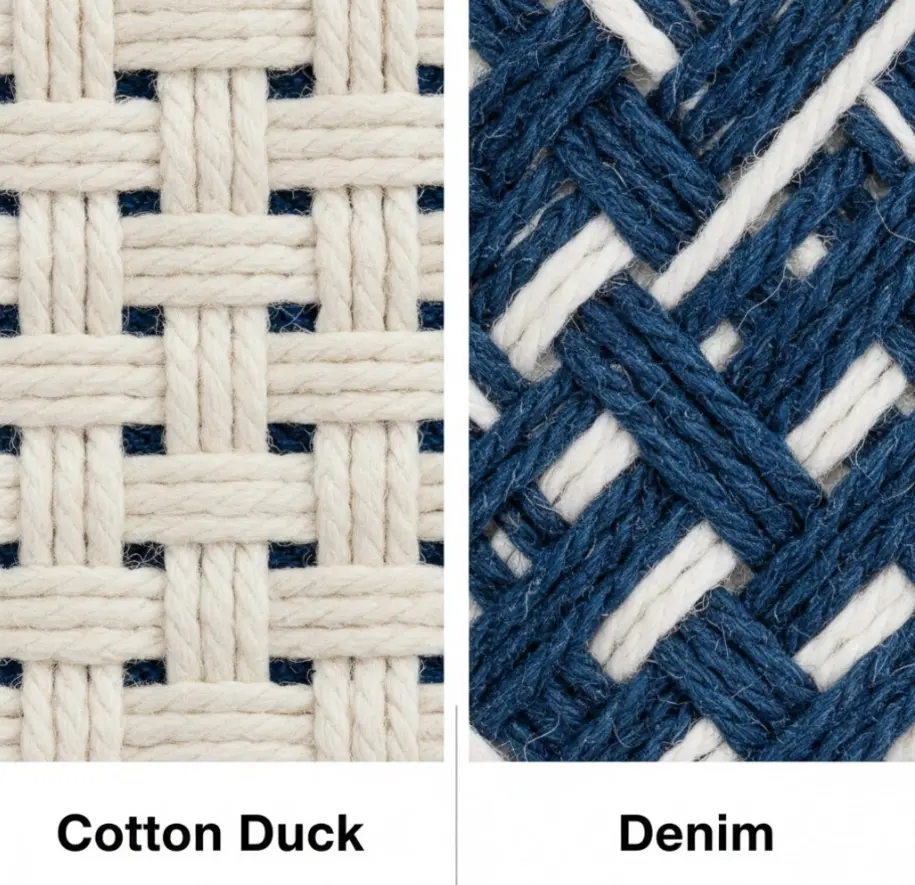
Source: canvasetc
This construction contributes to denim’s recognizable appearance:
- The outside is usually predominantly blue in indigo denim.
- The reverse side is lighter because more white weft is visible.
- Diagonal ribs are visible on the surface.
- The fabric tends to have structure and durability appropriate for garments such as jeans and jackets.
Not all denim looks identical. Right-hand twill, left-hand twill, and broken twill can produce different diagonal effects or reduce the obvious direction of the twill line. But they remain denim-related constructions because they retain the broader combination of twill structure and denim-like fabric character.
Indigo warp and white weft create the classic denim look
The most recognizable denim construction uses indigo-dyed warp yarns and white or natural weft yarns. Because the warp yarns dominate the face in a warp-faced twill, the visible side appears blue while the interior appears much paler.
This is why a conventional pair of blue jeans often looks blue outside and whitish inside. It is not usually because the finished fabric was dyed blue all the way through after weaving. Rather, the yarns were colored differently before weaving.
Indigo also contributes to denim’s aging behavior. The supplied research notes that indigo tends to remain more concentrated near the outer portion of cotton yarns than dyes that penetrate more fully. With wear and washing, the dyed outer surfaces can abrade and reveal lighter areas, creating the fading associated with many indigo denims.
However, indigo warp and white weft are best understood as the classic convention, not an absolute rule for every fabric sold as denim. Denim is available in black, gray, white, colored, coated, stretch, and other contemporary versions. Some fabrics may be dyed after weaving for a more uniform color. For example, so-called bull denim uses a denim-like twill construction but is dyed after weaving, so it does not show the usual blue-face-and-white-back contrast.
Weight and yarn choice matter, too
Denim is commonly associated with medium- to heavyweight cloth made for durability. Its yarns and construction are typically more substantial than those used in a light cotton twill shirt fabric. This is why denim often feels firmer when new and softens with wear and laundering.
Still, weight is not a strict definition by itself. There are lightweight denims for shirts and dresses, as well as heavy denims for jeans, outerwear, bags, and upholstery. A heavy cotton twill is not necessarily denim, and a lighter denim is not automatically excluded from the category.
Instead, weight should be read alongside the other clues:
- Is it a twill, especially a warp-faced one?
- Are the warp and weft visibly different in color?
- Does the face show the characteristic warp-dominant appearance?
- Is it built and marketed as a sturdy denim-type fabric?
- Does it have the expected structure and behavior for jeans, jackets, or similar garments?
Denim versus twill in practical terms
If you are choosing fabric for sewing, the most useful recommendation is to select by the result you need rather than treating “denim” and “twill” as interchangeable labels.
Choose denim when you want a recognizable jeans appearance, a visible blue-and-white yarn contrast, a sturdy casual look, and fabric that may develop wear patterns over time. Denim is a natural choice for jeans, chore jackets, overalls, skirts, workwear-inspired garments, and structured bags.
Choose a cotton twill when you want the strength and diagonal texture of twill but need a different color, softer hand, lighter weight, cleaner surface, or more tailored appearance. Cotton twill can work well for chinos, shirts, lightweight jackets, uniforms, home décor, and projects where a denim fade pattern is not wanted.
A fabric retailer’s comparison of denim and twill similarly notes that both can be tightly woven twills, but classic denim is identified by differently colored yarn systems, while many cotton twills are woven from similar-colored yarns and then dyed to one overall shade.
Why everyday language can be confusing
In everyday shopping language, “denim” can mean almost any blue fabric used to make jeans-style clothing. In textile terms, the word is more specific. A technical description generally points toward a durable cotton twill with a warp-dominant face and, traditionally, indigo warp yarns paired with lighter weft yarns.
Both uses are understandable, but they serve different purposes. A clothing shopper may reasonably call a blue stretch jean fabric “denim.” A weaver, fabric buyer, or sewist may want to know whether it is true indigo warp-faced denim, a garment-dyed twill, a cotton-polyester twill, or another fabric made to resemble denim.
The simplest rule is this: all denim is twill-based in the traditional sense, but not all cotton twill is denim. Denim becomes distinct through its usual warp-faced construction, its iconic indigo warp and white weft coloring, its durable character, and its long association with jeans and workwear.
References
- Cotton Twill Fabric vs Cotton Denim Fabric: Weave Differences. runliglobal.com. https://www.runliglobal.com/news/cotton-twill-fabric-vs-cotton-denim-fabric-weave-differences.html
- Denim vs Cotton: What’s the Difference?| StudioSuits. studiosuits.com. https://www.studiosuits.com/blogs/articles/denim-vs-cotton-whats-the-difference
- Comparing Denim & Twill Fabric. youtube.com. https://www.youtube.com/watch?v=yjWU8P2kzXw
- Stonemountain & Daughter Fabrics on Facebook: “You may see denim and twill recommended for the same patterns and wonder, well, what’s the differenc…”. facebook.com. https://www.facebook.com/StonemountainandDaughter/posts/you-may-see-denim-and-twill-recommended-for-the-same-patterns-and-wonder-well-wh/1713079874060584
- Denim - Wikipedia. en.wikipedia.org. https://en.wikipedia.org/wiki/Denim
- What’s the difference between twill and denim? - Quora. quora.com. https://www.quora.com/Whats-the-difference-between-twill-and-denim
- What Is Denim Fabric and How Is It Made? Complete Guide. omcottons.com. https://omcottons.com/blog/denim-fabric-how-is-it-made
- Different Denim Fabrics: Right-Hand, Left-Hand & Broken Twill - Long John. long-john.nl. https://long-john.nl/three-different-denim-fabrics-right-hand-left-hand-broken-twill