Why Does Fabric Feel Different After a Few Washes?
Table of Contents
Fabric can feel different after a few washes because its original hand is not determined by fiber content alone. New fabric may carry finishes that make it feel smoother, softer, crisper, fuller, or more even. Laundering gradually removes or alters some of those effects while also changing the fabric surface through water, detergent, friction, heat, and drying.
That is why fabric feels different after washing even when it has not visibly worn out. A shirt may become softer and more flexible, while a towel, sheet, knit, or brushed fabric may feel flatter, rougher, stiffer, or less plush. The result depends on the fiber, yarn, construction, finish, and laundry routine working together.
The new-store feel may partly be a finish
Fabric finishing is the set of treatments applied after a fabric is made to control its appearance, feel, drape, wrinkle behavior, or other performance characteristics. Some finishes are designed to last through repeated laundering, but others are less durable or are intentionally light surface effects.
A softener finish, for example, can make a new garment feel especially slick or smooth. A surface treatment can also help fibers lie in a more orderly direction, making the fabric feel polished at first. Once washing reduces that finish, the underlying yarns and fibers become more noticeable.
This does not automatically mean the fabric was poor quality. It may simply mean that the initial hand was partly created by finishing rather than being a permanent property of the construction. In a Reddit discussion about this issue, a user described fabric that felt great when new but became flatter or slightly rough after a few washes, and questioned how much of the original feel came from finishing rather than the fiber itself. That observation reflects a real shopping limitation: the hand in a store is not always the hand a fabric will have after laundering.
Washing changes the fabric surface
Every wash exposes fabric to water movement, contact with other textiles, detergent chemistry, and mechanical action. These forces can affect the outermost fibers first, which matters because fabric hand is largely a surface experience.
For cellulose fibers such as cotton, wetting can make the material more vulnerable to mechanical stress during washing. Repeated rubbing may lift small fiber ends, creating a slightly fuzzy or less even surface. On some fabrics this makes the material feel softer; on others it makes it feel drier, rougher, or less cleanly finished.
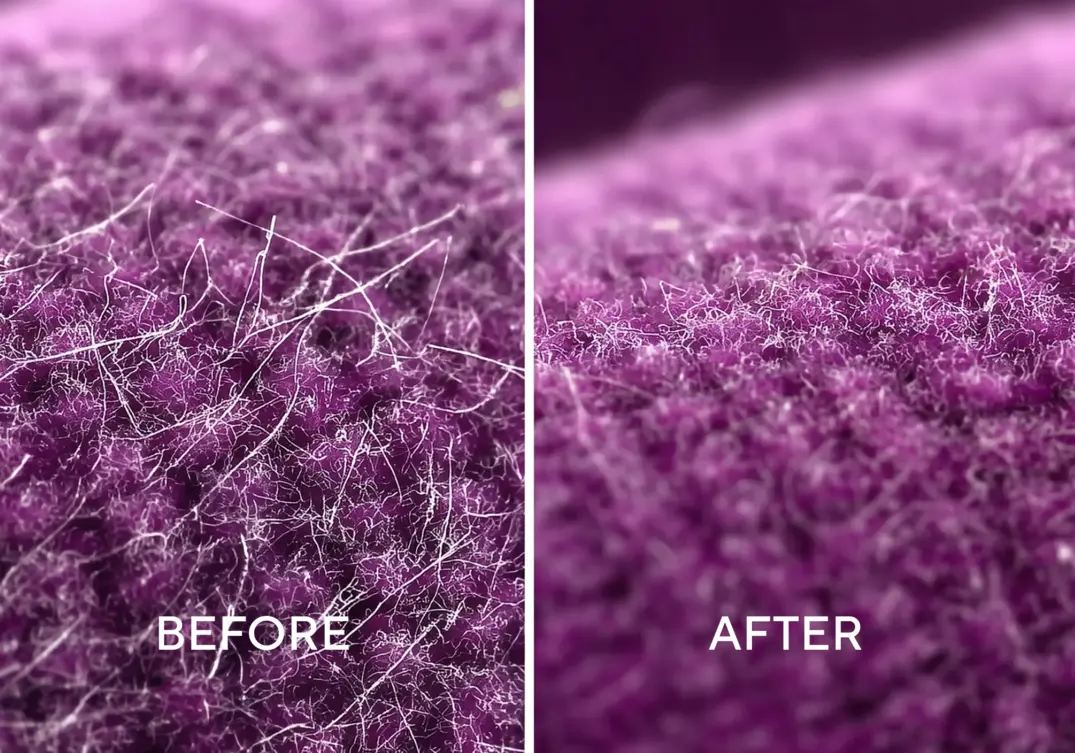
Source: bio-restore
Surface change can also make a fabric appear flatter. A brushed fleece, flannel, velour-like knit, or towel gets much of its softness and visual depth from raised fibers or loops. Those features can become compressed, tangled, worn down, or matted with repeated use and laundering. A smoother fabric may lose its crisp uniformity as fibers shift and the surface becomes less aligned.
Research on polyester fabric roughness likewise notes that washing-related changes can result from a combination of mechanical action, washing conditions, detergent residues, and hard-water effects. The study emphasizes that fabric-level surface roughness can change substantially after washing and that treatment durability varies by finish.
Fiber type matters, but it is not the whole answer
Fiber content gives useful clues, but it cannot fully predict washed fabric texture. Two cotton shirts can age very differently if one uses tightly twisted yarns and a dense knit while the other uses low-twist yarns and a lofty brushed finish.
Cotton and other cellulosic fabrics often become more relaxed and flexible with use. That may be perceived as pleasant softening. But if the surface develops more fuzz, residue, or abrasion damage, the same cotton can feel rougher instead.
Synthetic fibers such as polyester generally do not absorb water in the same way as cotton, but they can still change in hand. Their yarn structure, surface finish, and tendency to hold onto oils or residues can affect feel. Polyester blends may also change unevenly because the fibers in the blend respond differently to abrasion, heat, and moisture.
Wool, rayon, linen, and blends add further variables. A fabric’s washed behavior is therefore better understood as a system: fiber plus yarn plus construction plus finish plus care.
Yarn and construction influence whether fabric stays smooth or lofty
The yarns inside a fabric strongly shape its long-term hand.
Tighter-twist yarns generally hold fibers more securely and can produce a cleaner, firmer surface. Lower-twist yarns can create softness and bulk, but their loose fiber ends may be more easily disturbed by friction. Neither approach is universally better. A dense, tightly constructed fabric may retain a smooth appearance well but feel less lofty. A soft, open, brushed construction may be cozy initially but more likely to flatten with regular washing.
Knit fabrics can change particularly noticeably because their looped structure can relax, shift, or compact. Woven fabrics may retain a more stable geometry, although they can still become rougher if their surface fibers are abraded or coated with residue.
This is why a fabric that feels exceptionally soft in a store should be judged with some context. Very lofty, fuzzy, peach-skin, brushed, or heavily softened surfaces can be appealing, but their original texture may depend more on a delicate surface effect than a compact, durable structure.
Residue can make fabric feel stiff or scratchy
Not every hand change is permanent fiber wear. Sometimes fabric feels worse because something has been left on it.
Using too much detergent can make rinsing less effective, leaving residue that alters the surface feel. Hard water can add another issue: dissolved minerals can remain associated with the textile and contribute to a stiffer or duller hand. Fabric softener can temporarily mask roughness, but excess product may also leave buildup on some fabrics over time.
If several items suddenly feel less soft, look first at the laundry process rather than assuming all of the textiles have worn out. A properly sized load, a measured detergent dose, and sufficient rinsing can make a noticeable difference. The goal is not necessarily to use no detergent, but to use an amount the washer can rinse away effectively.
Drying conditions can flatten, stiffen, or roughen fabric
Drying is another major part of textile finishing wear at home. High heat and long dryer cycles can stress fibers and reduce the loft of raised surfaces. Tumbling also creates repeated friction, which may increase fuzz, pilling, or a worn-looking surface over time.
On the other hand, line drying can sometimes leave cotton feeling stiffer because the fabric dries without the flexing action of a dryer. That stiffness may be temporary rather than a sign of damage. A brief low-heat tumble, if allowed by the care label, can restore some flexibility without subjecting the item to a full hot drying cycle.
For fabrics valued for pile, softness, stretch, or smoothness, lower heat and avoiding overdrying are usually sensible precautions. Care labels remain the best starting point because the appropriate method depends on the particular garment and finish.
How to judge likely wash durability before buying
You cannot fully predict a fabric’s future hand from a quick touch, but you can look for clues.
Look beyond fiber content
A label that says “100% cotton” does not tell you whether the fabric is tightly woven, loosely knitted, brushed, heavily softened, dense, lightweight, or made with high- or low-twist yarns. Feel the fabric, but also inspect its surface and construction.
Check for a very temporary-looking surface effect
A fabric with an unusually slick, powdery, fuzzy, velvety, or heavily perfumed new feel may have received a substantial finishing treatment. That is not inherently undesirable, but shoppers should expect the effect to change somewhat with laundering.
Examine density and recovery
Hold the fabric to the light when possible. A very open structure may be more prone to distortion or flattening than a denser one. Gently compress a lofty fabric and see whether it springs back. This is only an in-store clue, not a durability test, but it can reveal whether the feel comes from resilient bulk or a delicate raised surface.
Read care instructions before treating texture as permanent
A garment that requires cold washing, gentle cycles, or line drying may still be an excellent choice, but it asks for care to preserve its intended hand. If easy-care durability is your priority, choose items whose construction and care guidance fit your actual laundry habits.
When a changed hand is normal—and when it signals a problem
A modest shift after the first few washes is common. Fabric may relax, lose a temporary finish, shed loose surface fibers, or settle into its natural drape. In some cases, this is the point at which the material begins to feel more authentic and comfortable.
More concerning signs include rapid thinning, severe pilling, a sticky or gummy feel, loss of stretch recovery, or a dramatic roughening that does not improve after better rinsing and adjusted drying. Those changes can point to excessive abrasion, residue buildup, heat exposure, or a construction and finish that are not holding up well.
The useful takeaway is that fabric hand is dynamic. The feel you notice after purchase is the first stage of a fabric’s life, not a permanent promise. Choosing construction and care practices that match your expectations gives you a better chance of liking the fabric after the newness has washed away.
References
- Why Do Clothes Become Rougher After Repeated Washing? (2026). shoppingstyle.us. https://www.shoppingstyle.us/why-do-clothes-become-rougher-after-repeated-washing
- Why Your Clothes Don’t Feel the Same After a Few Washes – Good Karma. madebygoodkarma.com. https://www.madebygoodkarma.com/blogs/good-karma-clothing/why-your-clothes-don-t-feel-the-same-after-a-few-washes
- Why Soft Clothes Feel Rough After Washing and How to Prevent It. oglmove.com. https://oglmove.com/blogs/basics/why-soft-clothes-feel-rough-after-washing-and-how-to-prevent-it
- Quantitative Analysis of the Impact of Finishing and Washing Processes on the Roughness of Polyester Fabric. pmc.ncbi.nlm.nih.gov. https://pmc.ncbi.nlm.nih.gov/articles/PMC11314936
- why does fabric feel so different after a few washes : r/textiles - Reddit. reddit.com. https://www.reddit.com/r/textiles/comments/1sio2ek/why_does_fabric_feel_so_different_after_a_few
- Why does fabric lose its softness after being washed multiple times .... quora.com. https://www.quora.com/Why-does-fabric-lose-its-softness-after-being-washed-multiple-times-especially-those-big-fuzzy-blankets
- Why Clothes Feel Hard After Washing & Easy Fixes That Actually Work. laundryinsigiriya.com. https://laundryinsigiriya.com/laundry-care-blog/why-clothes-feel-hard-after-washing-easy-fixes-that
- Why Cotton Sheets Feel Rough After Repeated Washes in Hard .... cleangearguide.com. https://cleangearguide.com/why-cotton-sheets-feel-rough-after-repeated-washes-in-hard-water