Why Is Wool So Popular for Fiber Arts?
Table of Contents
Wool is popular for fiber arts because it is unusually cooperative at nearly every stage of making. Its naturally crimped fibers hold together during spinning, its elasticity makes stitches forgiving, its resilience helps projects keep their shape, and its scales allow makers to intentionally felt it. Wool also takes dye well, creates warm yet breathable fabric, and comes in a wide range of textures—from very soft fine wools to sturdy rustic breeds.
For a new maker asking why wool is popular for fiber arts, the short answer is that wool does many useful things at once. It is not automatically the best fiber for every project, but it is one of the most versatile choices for knitting, crochet, spinning, weaving, and feltmaking.
Wool has natural crimp, which makes it easier to work with
A wool fiber is not perfectly straight. It has a natural waviness called crimp. When many crimped fibers are gathered together, they catch and hold one another more readily than smoother fibers. That is a major reason wool has historically been so useful for hand spinning.
Crimp helps loose wool fibers form a continuous strand before much twist is added. For spinners, this can make drafting—the controlled pulling-out of fiber supply—more manageable. A yarn spun from wool can also hold together with less twist than a slicker, straighter fiber may need.
This structure affects finished yarn as well. Crimp creates little spaces between fibers, giving wool yarn bulk and loft. Rather than packing into a dense, flat mass, many wool yarns create a springy structure with air trapped inside. That air contributes to insulation and gives knitted fabric a pleasing, cushioned feel.
Source: gpktt.weebly
Fine wools often have more crimp than coarse wools, but wool is not one uniform material. Breed, fiber diameter, staple length, preparation, spinning method, and yarn construction all influence how a particular wool yarn behaves. That variety is part of wool’s appeal: a maker can choose a soft, smooth yarn for close-to-skin garments or a more robust wool for mittens, rugs, or outer layers.
Wool elasticity makes knitting more forgiving
One of the most useful wool yarn properties is elasticity: the ability to stretch and then recover toward its previous shape. Wool fibers can stretch substantially and recover, which helps wool fabrics resist permanent distortion after ordinary movement and handling.
For knitting with wool, this recovery has practical benefits:
- Stitches are easier to tension. Wool yarn has some give as it moves through the hands and around a needle or hook.
- Ribbing works well. Cuffs, neckbands, and hems made with wool often retain useful stretch and rebound.
- Garments can fit comfortably. A wool sweater can accommodate movement without feeling as rigid as a fabric made from a less elastic yarn.
- Minor tension variation is less obvious. New knitters and crocheters may find that wool’s spring disguises small inconsistencies better than a smooth, inelastic yarn.
Elasticity is related to resilience but is not exactly the same thing. Elasticity concerns stretch and recovery; resilience concerns resistance to flattening, creasing, and repeated deformation. Wool performs well in both areas. Its fibers withstand repeated bending, and its loft can recover after compression. That is why a wool hat or blanket can feel springier than a similar item made from a denser, less resilient yarn.
This does not mean every wool yarn is bouncy. A tightly spun yarn, a smooth long-staple wool, or a wool blended with drapier fibers can feel comparatively firm. Still, wool’s built-in recovery is a key reason it is widely recommended for sweaters, hats, mittens, socks, and textured stitch patterns.
Wool is warm without simply feeling sealed in
Wool is associated with warmth because its crimped structure traps air. Air is a poor conductor of heat, so a lofty wool yarn can reduce heat loss. The amount of warmth depends on the yarn and fabric construction: a fluffy, woolen-spun yarn knitted at a relaxed gauge traps more air than a compact, tightly knitted fabric.
Wool also interacts with moisture differently from many synthetic fibers. It can absorb water vapor within the fiber while its outer surface tends to resist liquid water to a degree. In normal use, this can help wool feel less clammy when humidity or perspiration changes. Wool’s moisture regain also helps reduce static compared with very low-moisture-regain fibers.
For makers, that combination makes wool particularly useful for cool-weather clothing, blankets, slippers, hats, and outdoor layers. It can offer insulation even when conditions are damp, though it is not waterproof and should not be treated as a substitute for rain gear.
Wool takes color well and offers many surface effects
As an animal protein fiber, wool has a strong affinity for many dyes. This gives dyers a broad palette and helps explain the long tradition of richly colored wool yarns and textiles. Hand-dyed wool is especially common in knitting and spinning because the fiber can show tonal shifts, speckles, heathered effects, and layered colors beautifully.
Wool also has enough surface texture to make stitch definition, halo, and loft vary dramatically from yarn to yarn. A smooth worsted-spun wool can show cables and lace clearly. A woolen-spun yarn can bloom into a softer, more atmospheric fabric. A tweedy yarn may add visual texture even in plain stockinette or simple crochet stitches.
For crochet, wool’s grip can be useful when making amigurumi, sturdy baskets, textured hats, or motifs that benefit from structure. For weaving, its spring and ability to full can be useful in blankets, tapestry, and dense cloth. For spinning, different preparations—such as combed top or carded roving—allow makers to choose between smoother and loftier yarns.
Wool felting is a feature, not always a flaw
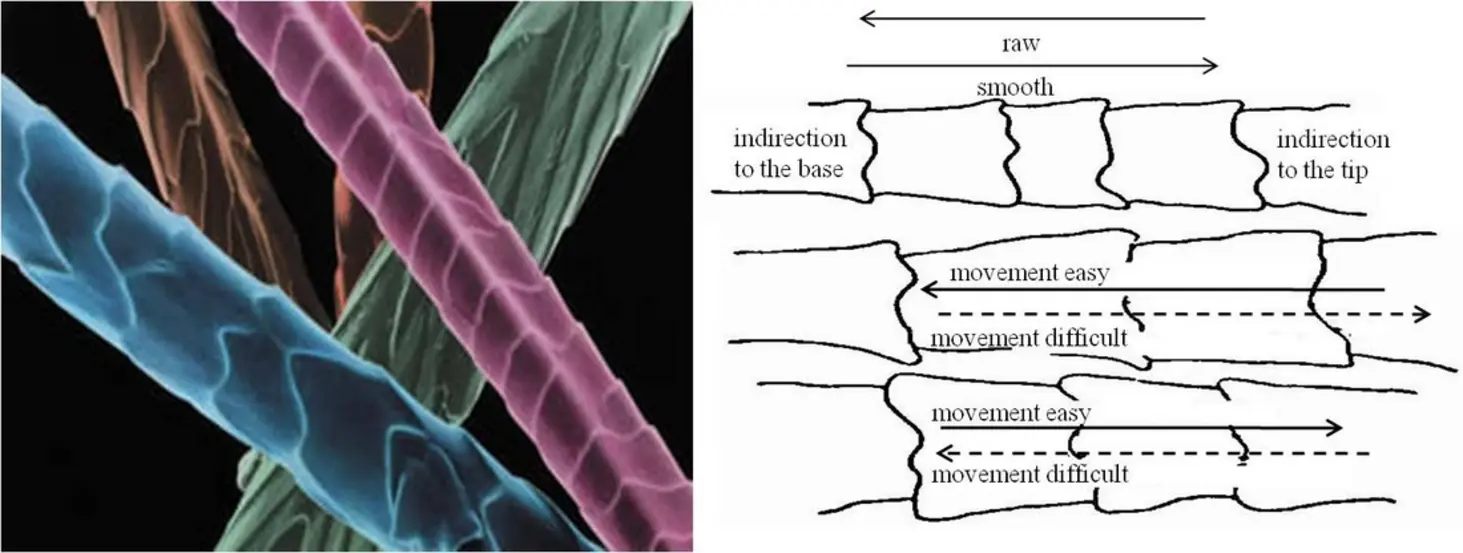
Wool’s outer surface has overlapping scales. With moisture, heat, soap, and agitation, those scales can move past one another and become increasingly interlocked. The result is felting: the fabric or loose fiber contracts and becomes denser.
This is one of wool’s most distinctive creative possibilities. Makers use it intentionally in several ways:
- Wet felting, which uses warm water, soap, and agitation to turn loose wool into dense fabric.
- Needle felting, which uses a barbed needle to tangle fibers into sculptural forms or decorative designs.
- Fulling knitted or woven fabric, which intentionally shrinks and thickens a completed item.
Felting makes wool useful for projects such as slippers, bowls, ornaments, toys, bags, hats, wall art, and dense weather-resistant fabric. It also gives makers a way to reshape or strengthen a project after knitting or weaving.
The tradeoff is important: wool can felt accidentally. A garment that is not labeled machine washable may shrink or mat if it is washed with heat, friction, or agitation. Superwash wool has been treated or modified to reduce felting, which can make it easier to care for but makes it less suitable when deliberate wet felting is the goal.
Why wool is especially friendly for beginners
A beginner does not need to understand fiber science to benefit from wool. In practice, wool is often easier to learn on because it has grip. Stitches are less likely to slide off needles than they are with very slick fibers such as silk, rayon, or some bamboo yarns. It is also easier to see and manipulate than many fuzzy novelty yarns.
A smooth, light-colored, medium-weight wool yarn is often a practical learning material for knitting or crochet. The light color makes individual stitches easier to see; the smooth construction makes it easier to identify mistakes; and the wool’s elasticity keeps the fabric manageable.
A beginner-oriented discussion on Reddit’s r/YarnAddicts asked this same basic question: why wool is so widely used in fiber arts. The question reflects a common early realization for new makers—wool’s reputation is not based on tradition alone, but on practical behavior while making and wearing finished work.
When wool may not be the best choice
Wool has limits, and choosing another fiber can be sensible.
Some people find certain wools itchy, especially coarser grades. Fiber diameter matters: finer wool fibers tend to feel softer because they bend more easily against the skin, while coarser fibers can feel prickly. If sensitivity is a concern, swatch and wear-test the yarn against the neck or wrist before committing to a large garment.
Wool also requires care appropriate to the yarn. Many wool items should be hand-washed gently and dried flat, although some superwash yarns are designed for machine washing. Always follow the yarn label rather than assuming every wool behaves alike.
It may not be the best choice for projects that need strong drape, such as a flowing summer shawl or a fluid camisole. Plant fibers, silk, rayon, or blends may provide a heavier, more drapey result. Wool can also be less ideal for very hot weather, though lightweight wool fabrics can still be useful because of their moisture behavior.
For hard-wearing socks, wool is often blended with nylon because nylon improves abrasion resistance. For a dishcloth, cotton is usually a more practical choice because it is inexpensive, washable, and suited to repeated wet use. For a project meant to be intentionally slick, cool, or highly draped, a different fiber may better match the design.
The practical reason makers keep returning to wool
Wool is popular because its natural structure solves many craft problems at once. Crimp gives it cohesion and loft. Elasticity supports stitch recovery and comfortable fit. Resilience helps fabric bounce back. Moisture behavior supports comfort. Dye affinity expands color options. Surface scales make felting possible.
That combination gives wool an unusually broad range: it can become a crisp cable sweater, a soft shawl, a sturdy mitten, a lofty handspun skein, a woven blanket, or a dense felted vessel. Choosing wool is not about following a rule that natural fibers are always superior. It is about selecting a fiber whose strengths match the project you want to make.
References
- Why Wool Is the Most Popular Fiber for Hand Spinning. rileywoodandfiberart.com. https://rileywoodandfiberart.com/blogs/fiber-arts-guides/why-many-spinners-love-working-with-wool
- Genuine question - why is wool so popular for fiber arts?. reddit.com. https://www.reddit.com/r/YarnAddicts/comments/1d7l1uz/genuine_question_why_is_wool_so_popular_for_fiber
- Yarn Fiber Properties: A Crafter’s Complete Guide. lionbrand.com. https://www.lionbrand.com/community/blog/yarn-fiber-properties-a-crafters-complete-guide
- Wool - Wikipedia. en.wikipedia.org. https://en.wikipedia.org/wiki/Wool
- the problem why does wool outperform other fibers?. fabrica.com. https://www.fabrica.com/wp-content/uploads/2026/09/Wool-Manages-Humidity.pdf
- Wool: From Properties and Structure to Genetic Insights and Sheep Improvement Strategies. pmc.ncbi.nlm.nih.gov. https://pmc.ncbi.nlm.nih.gov/articles/PMC12523852
- Wool: A Fiber Artist’s Guide - Knitfarious. knitfarious.com. https://knitfarious.com/wool-a-fiber-artists-guide