Yarn Strength and Unevenness: Measurement, Irregularity Types and Regularity
Table of Contents
Yarn Strength Requirements and Count Correction
Required yarn strength is determined by end use rather than by count alone. A warp yarn for a closely set woven fabric must withstand repeated tension, abrasion and loom movement, while a knitting yarn may need greater extensibility, softness and loop-forming performance. Sewing threads, industrial yarns and export yarns can have additional customer specifications for breaking force, tenacity, elongation or minimum strength consistency.
Yarn strength is commonly reported as a single-yarn breaking force, lea strength, tenacity, count-strength product (CSP), elongation at break or breaking length. These measures are related, but they are not interchangeable without attention to count system, specimen configuration and units.
When lea strength is measured on yarn whose actual count differs from the nominal count, the result may be corrected to allow comparison at the specified count. In the cotton count system, CSP is conventionally expressed as:
[ \text{CSP} = \text{lea strength} \times N_e ]
where lea strength is normally expressed in pounds-force and (N_e) is the actual cotton count. If a measured lea strength (S_1) belongs to actual count (C_1), and the equivalent strength at nominal count (C_2) is required, a constant-CSP correction is:
[ S_2 = S_1 \times \frac{C_1}{C_2} ]
Here, (S_2) is corrected lea strength at the nominal count. This correction assumes that CSP is unchanged; it is a comparison tool, not proof that two yarns have identical fiber quality, twist level or strength distribution.
When Single-Yarn Strength Testing Is Useful
Single-yarn tensile testing measures the force and extension of individual yarn specimens pulled to rupture under controlled conditions. It is useful when average lea strength does not provide enough information about variability, weak places or elongation behavior. A tensile tester can report breaking force, tenacity, elongation at break and, where required, work to rupture.
Single-thread results should be interpreted separately from lea strength. A lea test breaks a bundle of yarns, while a single-yarn test characterizes individual specimens. Fabric strip strength is another separate property because fabric construction, yarn interaction, crimp and load sharing affect the final result.
Export Yarn Specifications and RKm
Some yarn specifications use RKm, also written as Rkm or breaking length, particularly in metric-based trade and technical documentation. Breaking length is the theoretical length of yarn that would break under its own suspended weight if its tensile behavior remained uniform along that length.
RKm is closely related to tenacity. When tenacity is expressed in grams-force per tex, the numerical value corresponds approximately to breaking length in kilometres. In SI practice, tenacity may be reported in centinewtons per tex; this value is very close to RKm, with a small difference caused by the conversion between gravitational and SI force units.
For a yarn tested as a single thread, breaking length can be calculated from breaking force and linear density, provided consistent units are used. In practical quality work, laboratories should state whether force is reported in cN, N or gf and whether yarn fineness is in tex, dtex, Nm or cotton count. A numerical conversion should not be applied blindly across test reports using different systems.
Lea strength can support commercial yarn assessment, but it is not a direct substitute for a single-yarn RKm value. Bundle testing and single-yarn testing have different failure behavior because individual ends in a lea do not necessarily reach rupture at exactly the same load. Where a buyer specifies single-thread tenacity or breaking length, direct single-yarn testing is the more defensible method.
Evaluating Strength and Elongation Changes After Sizing
Sizing is applied mainly to warp yarns to improve resistance to abrasion, reduce hairiness and improve weaving performance. A properly selected size formulation can increase the force needed to break a yarn, but excessive size pickup or excessive stiffness can reduce extensibility and make the warp less tolerant of dynamic loom stresses.
Before-and-after testing is therefore valuable. Comparable yarn samples should be conditioned and tested using the same gauge length, rate of extension and sampling plan. The assessment should examine mean breaking force, elongation at break and variability, rather than relying on a strength increase alone.
The desired result is a workable balance: sufficient improvement in strength and abrasion resistance, while retaining enough extension for weaving. Acceptance limits should be agreed for the specific yarn, loom type, fabric construction and sizing system. A universal percentage target is not suitable because fiber type, twist, yarn count and end-use stress differ substantially.
Using Yarn Strength to Estimate Fabric Strip Strength
Fabric strip strength depends partly on the number of load-bearing yarns in the test width and the strength of those yarns. As a preliminary planning relationship, the theoretical yarn contribution can be expressed as:
[ \text{Estimated strip load} = n \times \bar{F} \times k ]
where (n) is the number of yarns participating in the tested strip width, (\bar{F}) is mean single-yarn breaking force, and (k) is an efficiency or correction factor. The factor accounts for effects such as yarn quality variation, yarn crimp, weave structure, thread density, fabric mobility and unequal load sharing.
This is an estimating method, not a replacement for fabric testing. Strip-test results also depend on test direction, specimen width, clamping conditions and the relevant test method. Warp and weft fabric strength should therefore be confirmed on finished or representative fabric when a product specification is critical.
Why Yarn Unevenness and Imperfections Matter
Yarn unevenness is variation in mass, diameter or apparent thickness along its length. Even when the average yarn count is correct, local thick and thin places can create visible and performance-related problems. A thick segment may produce a prominent line, knot-like appearance or local cover increase, while a thin segment can reduce strength and create a lighter or more open area in fabric.
Yarn irregularity is especially important where fabrics have smooth surfaces, light shades, fine constructions or uniform dyeing requirements. In these cases, small local differences in yarn cover can become visible as barré, streakiness, patchiness or uneven surface texture.
Unevenness also affects processing. During winding, warping and weaving, weak thin places may increase end breaks. Thick places can interfere with guides, drop wires, heddles and reed passages. In knitting, mass variation can affect loop appearance and fabric uniformity. Subsequent dyeing, finishing and inspection may make the consequences more apparent rather than removing them.
Measuring Yarn Unevenness With an Uster Evenness Tester
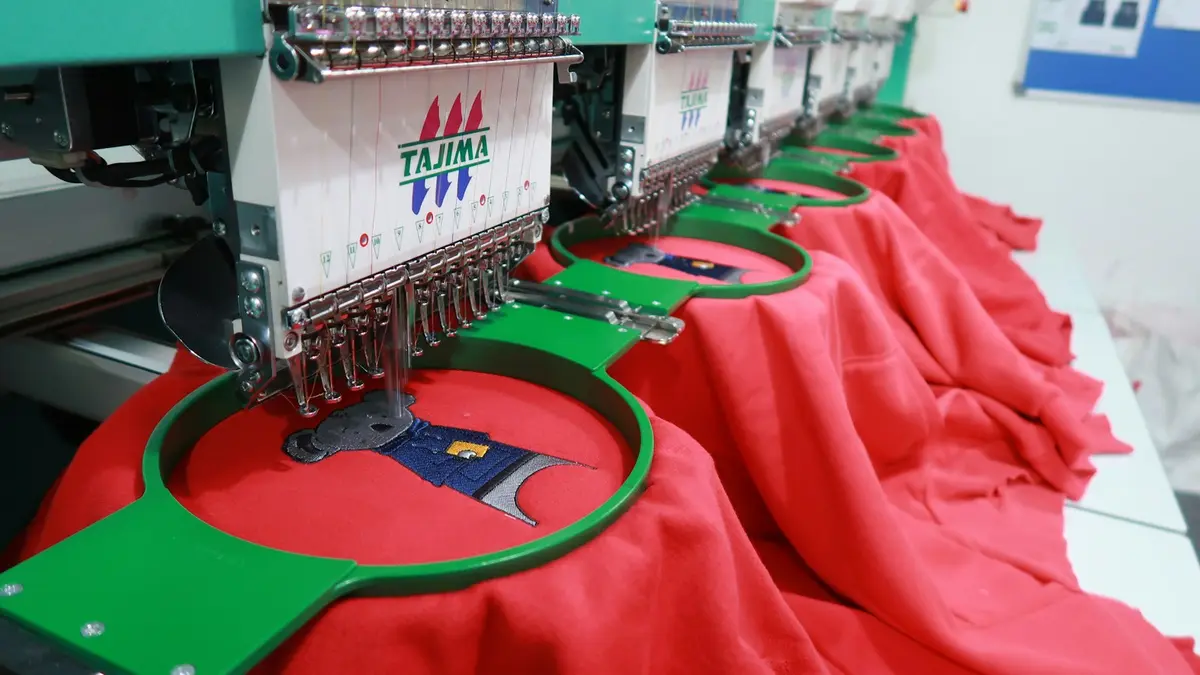
Electronic evenness testing evaluates short-length variation in a moving strand. Capacitive instruments, commonly associated with Uster-type evenness testing, detect changes related to the mass of fiber material passing through a sensing field. The resulting signal represents variation along the yarn, sliver or roving length rather than a direct optical measurement of diameter alone.
Source: Unsplash
Two common summary measures are U% and CV%. U% is based on mean absolute deviation from the average mass, while CV% is based on standard deviation relative to the mean. For a normal distribution, the approximate relationship is:
[ \text{CV%} \approx 1.25 \times \text{U%} ]
The relationship is approximate because real yarn mass distributions may be skewed or influenced by faults, splices and periodic variation. U% and CV% should therefore be compared only with reports using compatible settings and evaluation conditions.
Representative sampling is essential. Packages should be selected across the lot, machine positions and production time where practical. Test speed, total tested length, clearing settings and instrument configuration affect results. Laboratories should follow the relevant instrument procedure or customer method and report the sampling basis rather than treating one package result as a complete description of production quality.
Evenness testing can also record imperfections such as thin places, thick places and neps at selected sensitivity levels. These fault counts help identify process issues, but their interpretation must consider yarn count, raw material, spinning system and fabric end use.
Types of Yarn Irregularity
Yarn irregularity is generally described as random, periodic or quasi-periodic. The distinction matters because each form points to different causes and corrective actions. Random variation is inherent in the statistical arrangement of fibers, whereas periodic and quasi-periodic faults often indicate drafting, roller, gear or material-control problems.

Source: Unsplash
Random Irregularity
Random irregularity is the theoretical minimum variation associated with the random distribution of fibers in a yarn cross-section. If fibers are assumed to be identical and independently distributed, the number of fibers in a short yarn segment can be described using a Poisson-type model.
Under this simplified condition, the relative variation in fiber number decreases as the average number of fibers in the yarn cross-section increases. A basic expression for the limiting coefficient of variation is:
[ \text{CV%}_{\min} = \frac{100}{\sqrt{n}} ]
where (n) is the mean number of fibers in the yarn cross-section. Fine yarns, coarse fibers and low fiber counts generally lead to a higher theoretical minimum variation than yarns containing more fibers in the cross-section.
Actual yarn irregularity is usually higher than this idealized limit. Fibers vary in fineness, length, density and orientation, and spinning processes introduce additional drafting and control variation. The equation is therefore most useful as a conceptual benchmark, not as a complete prediction for cotton, regenerated-cellulosic or synthetic yarns.
Periodic Irregularity
Periodic irregularity consists of regularly repeated thick and thin places at a relatively constant spacing. It is commonly associated with mechanical sources, including eccentric rollers, damaged gears, worn bearings, roller-speed variation or recurring changes in drafting geometry.
A winding board can provide a visual clue. If regularly spaced thick places are wound in successive layers, they may form repeated diagonal, curved or U-shaped patterns. The pattern spacing can help technicians trace the fault back to a roller circumference, gear cycle or drafting element.
The wavelength of a periodic fault is the yarn length between successive repeating features. It should be calculated from the actual winding-board dimensions and winding geometry, not from a universal board formula. Once the wavelength is known, it can be compared with roller circumferences and machine transmission cycles to identify likely causes.
Quasi-Periodic Irregularity and Drafting Waves
Quasi-periodic irregularity has a recognisable repeating tendency, but its wavelength and amplitude are not constant. It differs from a true periodic fault because the pattern changes over time or along the yarn length.
Drafting waves are an important example. In roller drafting, fibers may move unevenly through the drafting zone when control is insufficient. The result can be broad mass waves rather than sharply repeated mechanical faults. Such waves may originate in card sliver, drawframe sliver, roving or the final spinning stage and can persist into yarn.
Short-fiber content is a major influence because short fibers are harder to control between roller nips. Roller settings, break draft, total draft, pressure, apron condition, fiber friction and the effectiveness of fiber-control systems can all affect wave amplitude. Process settings should be optimized for the fiber length distribution and spinning route rather than applying one setting to every material.
Because drafting waves can vary in both size and spacing, spectral analysis and instrument diagrams are often more informative than one overall U% or CV% value. A yarn may have an acceptable average unevenness result yet still show objectionable long-wave variation in a sensitive fabric.
Yarn Regularity and Intended Variation
Yarn regularity describes the consistency of yarn appearance and internal structure along its length. A regular yarn generally has stable mass distribution, fiber arrangement and diameter, supporting more uniform processing and fabric appearance.
Regularity is influenced by fiber-length variation, fiber fineness, fiber distribution, degree of parallelism and the effectiveness of opening, blending, carding, drawing and drafting. Fibers with broad length variation or poor parallelization are more difficult to control, particularly when short fibers are present in significant proportion.
Internal uniformity is closely connected to yarn quality, but the required level depends on product purpose. Fine shirting, smooth knitwear, high-density weaving and light-colored fabrics usually demand high regularity. Some upholstery, denim, woolen-spun and textured products may tolerate or deliberately use more visual variation.
Not all variation is a defect. Fancy yarns may intentionally include slubs, loops, thick-and-thin effects, color changes or component differences to create a designed appearance. Composite yarns can also show structural variation because they contain more than one component. Quality assessment should distinguish controlled, repeatable design features from unintended irregularity that causes processing problems or inconsistent fabric performance.